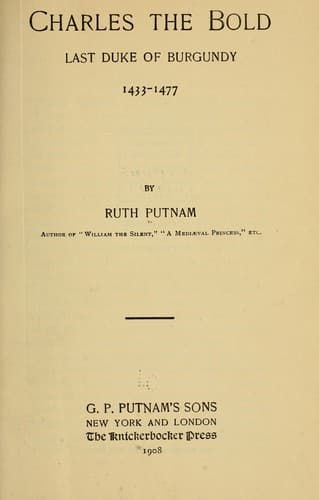
Charles the Bold, Last Duke of Burgundy, 1433-1477Putnam, Ruth
History
Charles the Bold, Last Duke of Burgundy, 1433-1477
Putnam, Ruth
Burgundy (France) -- History; Charles, Duke of Burgundy, 1433-1477; Switzerland -- History -- 1032-1499
In that town the duke's lieutenant, Humbercourt, had been left to
supervise the humiliating changes ordered. And the work of demolition
was the only industry. Other ordinary business was at a standstill.
For a period there was a sullen silence in the streets and the church
bells were at rest. In April, a special legate from the pope arrived
to see whether ecclesiastical affairs could not be put on a better
footing.
It was about the same time that the States-General were meeting
at Tours that, under the direction of this legate, Onofrio de
Santa-Croce, the cathedral was purified with holy water, and Louis of
Bourbon celebrated his very first mass, though he had been seated on
the episcopal throne for twelve years. Then Onofrio tried to mediate
between the city and the Duke of Burgundy. To Bruges he went to
see Charles, and obtained permission to draft a project for the
re-establishment of the civic government, to be submitted to the duke
for approval.
If Onofrio thought he had reformed the bishop by forcing him into
performing his priestly rites he soon learned his mistake. That
ecclesiastic speedily disgusted his flock by his ill-timed
festivities, and then forsook the city and sailed away to Maestricht
in a gaily painted barge, with gay companions to pass the summer in
frivolous amusements suited to his dissolute tastes. Such was the
state of affairs when the report of Louis's extensive military
preparations encouraged the Liegeois to hope that he was to take the
field openly against the duke.
About the beginning of September, troops of forlorn and desperate
exiles began to return to the city. They came, to be sure, with shouts
of _Vive le Roi!_ but, as a matter of fact, they seemed willing to
make any accommodation for the sake of being permitted to remain.
"Better any fate at home than to live like wild beasts with the
recollection that we had once been men."
To make a long story short, Onofrio again endeavoured to rouse the
bishop to a sense of his duty. Again he tried to make terms for the
exiles and to re-establish a tenable condition. It was useless. Louis
of Bourbon refused to approach nearer to Liege than Tongres, and
declined to meet the advances of his despairing subjects. It was just
at this moment that fresh emissaries arrived from Louis, despatched,
as already stated, _before_ Charles had consented to prolong the
truce.
Excited by their presence the Liegeois once more roused themselves to
action. A force of two thousand was gathered at Liege, and advanced by
night upon Tongres--also without walls--surrounded the house where lay
their bishop, and forced him to return to Liege. Violence there was
and loss of life, but, as a matter of fact, the mob respected the
person of their bishop and of Humbercourt the chief Burgundian
official. This event happened on October 9th, the very day that Louis
rode recklessly into Peronne.
Public-domain text, read in full here on John Shaqi.
Reviews
Reviews
No reviews yet
Be the first to share your thoughts on this work.
Elsewhere in the archive
Join the Discussion
Join the discussion
Sign in to leave a comment or review.
Sign InorCreate an account