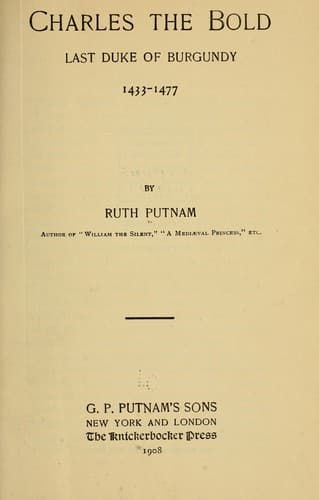
Charles the Bold, Last Duke of Burgundy, 1433-1477Putnam, Ruth
History
Charles the Bold, Last Duke of Burgundy, 1433-1477
Putnam, Ruth
Burgundy (France) -- History; Charles, Duke of Burgundy, 1433-1477; Switzerland -- History -- 1032-1499
"Diverse were the opinions in the above-mentioned council-meeting.
Some held that the safe-conduct accorded to the king protected
him, seeing that he fairly observed the peace as it had been
stated in writing. Others rudely urged his capture without further
ceremony, while others again advised sending for his brother, the
Duke of Normandy, and concluding with him a peace to the advantage
of all the princes of France. They who gave this advice thought
that in case it was adopted, the king should be restrained of his
liberty. Further, it was against all precedent to free so great a
seigneur when he had committed so grave an offence.
"This last argument so nearly prevailed that I saw a man booted
and spurred ready to depart with a packet of letters addressed to
Monseigneur of Normandy, being in Brittany, and stayed only for
the Duke of Burgundy's letter. However, this came to naught. The
king made overtures to leave as hostages the Duke of Bourbon, the
cardinal, his brother, and the constable with a dozen others while
he should be permitted to return to Compiegne after peace was
concluded. He promised that the Liegeois should repair their
mischief or he would declare himself their foe. The appointed
hostages were profuse in their offers to immolate themselves, at
least they were in public. I do not know whether they would have
said the same things in private. I rather suspect not. And in
truth, I believe that those who were left would never have
returned.
"On the third night after the arrival of the news, the duke never
undressed, but lay down two or three times on his bed, and
then rose and walked up and down. Such was his way when he was
troubled. I lay that night in his chamber and talked with him from
time to time. In the morning his fury was greater than ever, his
tone very menacing, and he seemed ready to go to any extreme.
"However, he finally brought himself to say that if the king would
swear the peace and would accompany him to Liege to help avenge
Monsgn. of Liege, his own kinsman, he would be satisfied. Then
he suddenly betook himself to the king's chamber and expressed
himself to that effect. The king had a friend[15] who warned him,
assuring him that he should suffer no ill if he would concede
these two points. Did he do otherwise he ran grave risk, graver
than he would ever incur again."
Public-domain text, read in full here on John Shaqi.
Reviews
Reviews
No reviews yet
Be the first to share your thoughts on this work.
Elsewhere in the archive
Join the Discussion
Join the discussion
Sign in to leave a comment or review.
Sign InorCreate an account