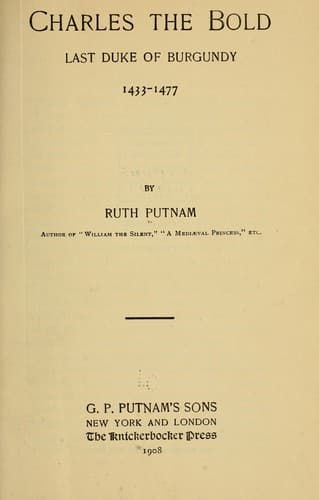
Charles the Bold, Last Duke of Burgundy, 1433-1477Putnam, Ruth
History
Charles the Bold, Last Duke of Burgundy, 1433-1477
Putnam, Ruth
Burgundy (France) -- History; Charles, Duke of Burgundy, 1433-1477; Switzerland -- History -- 1032-1499
Quaking with fear was the king. He thought that if the duke should now
fail to make a complete conquest of Liege, his own fate would hang in
the balance. At a hasty council meeting held that night, Charles
was very doubtful as to the expediency of carrying out his proposed
assault upon the city. Very distrustful of each other were the allies,
a fact that caused Philip de Commines to comment,[3] "scarcely fifteen
days had elapsed since these two had sworn a definitive peace and
solemnly promised to support each other loyally. But confidence could
not enter in any way."
Charles gave Louis permission to retire to Namur and wait until the
duke had reduced the recalcitrant burghers once for all. Louis thought
it wiser to keep close to Charles's own person until they parted
company for ever, and the morrow found him in the duke's company as he
marched on to Liege.
"My opinion is, [says Commines], that he would have been wise to
depart that night. He could have done it for he had a hundred
archers of his guard, various gentlemen of his household, and,
near at hand, three hundred men-at-arms. Doubtless he was stayed
by considerations of honour. He did not wish to be accused of
cowardice."
Olivier de la Marche, also present as the princely pair entered Liege,
heard the king say: "March on, my brother, for you are the luckiest
prince alive." As they entered the gates, Louis shouted lustily,
"_Vive Bourgogne_," to the infinite dismay of his former friends, the
burghers of Liege.
The remainder of the history of that dire Sunday morning differs from
that of other assaults only in harrowing details, and the extremity of
the pitilessness and ferocity manifested by the conquerors. Charles
had previously spared churches, and protected the helpless. Above
all he had severely punished all ill treatment of respectable women.
Little trace of this former restraint was to be seen on this occasion.
The inhabitants were destroyed and banished by dozens. Those who fled
from their homes leaving their untasted breakfasts to be eaten by the
intruding soldiers, those who were scattered through the numerous
churches, those who attempted to defend the breaches in the walls--all
alike were treated without mercy.
The Cathedral of St. Lambert, Charles did endeavour to protect. "The
duke himself went thither, and one man I saw him kill with his own
hand, whereupon all the company departed and that particular church
was not pillaged, but at the end the men who had taken refuge there
were captured as well as the wealth of the church."
[Illustration: OLIVIER DE LA MARCHE
(FROM MS. REPRODUCED IN MÉM. COURONNÉS, ETC., PAR L'ACAD,
ROYALE DE BELGIQUE VOL. XLIX.)]
Public-domain text, read in full here on John Shaqi.
Reviews
Reviews
No reviews yet
Be the first to share your thoughts on this work.
Elsewhere in the archive
Join the Discussion
Join the discussion
Sign in to leave a comment or review.
Sign InorCreate an account