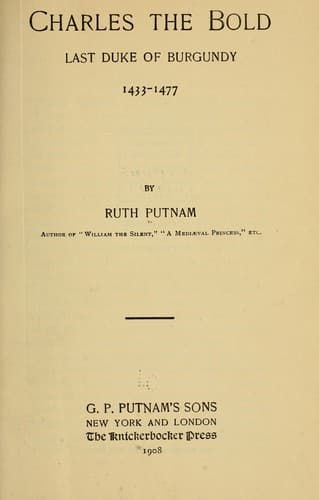
Charles the Bold, Last Duke of Burgundy, 1433-1477Putnam, Ruth
History
Charles the Bold, Last Duke of Burgundy, 1433-1477
Putnam, Ruth
Burgundy (France) -- History; Charles, Duke of Burgundy, 1433-1477; Switzerland -- History -- 1032-1499
The ratification of the treaty took place duly at Paris on Saturday,
November 19th, and the king also sternly forbade the circulation of
any "paintings, rondels, ballads, songs, or defamatory pamphlets"
about Charles.[11] The same informant tells us that loquacious birds
were put under a ban.
"And on the same day in behalf of the king, and by virtue of his
commission addressed to a young man of Paris named Henry Perdriel,
all the magpies, jays, and _chouettes_, caged or otherwise, were
taken in charge, and a record was made of all the places where the
said birds were taken and also all that they knew how to say, like
_larron, paillart_, etc., _va hors, va! Perrette donnes moi à
boire_, and various other phrases that they had been taught."
Abbé le Grand thinks that "Perrette" was meant for Peronne instead of
a mistress of Louis of that name. But this conjecture seems the only
basis for the very deep-rooted tradition that _Peronne_ was a word
Louis could not bear to have uttered.
"In the way of justice there is nothing going on here, [wrote one
Anthony de Loisey from Liege to the president of Burgundy], except
every day they hang and draw such Liegeois as are found or have been
taken prisoners and have no money to ransom themselves. The city is
well plundered, nothing remains but rubbish. For example I have not
been able to find a sheet of paper fit for writing to you, but with
all my pains could get nothing but some leaves from an old book."[12]
Charles decided that nothing should be left standing except churches
and ecclesiastical buildings. On November 9th, before the final fires
were lit, he departed from the wretched town and went down the left
bank of the Meuse to an abbey on the river, where he paused for the
night. Four leagues distant from the city was this place, and from it
were plainly visible the flames of the burning buildings on that grim
St. Hubert's Day--a day when Liege had been wont to give vent to
merriment.
"From all the dangers that had encompassed him, Charles escaped with
his life, simply because his hour had not yet struck, and because
he was God's chosen instrument to punish the sinning city," is the
verdict of one chronicler who does not spare his fellow-Liegeois for
their follies while he profoundly pities their fate.[13]
Out of the many contemporaneous accounts a portion of a private letter
from the duke's cup-bearer to his sister is added:[14]
Public-domain text, read in full here on John Shaqi.
Reviews
Reviews
No reviews yet
Be the first to share your thoughts on this work.
Elsewhere in the archive
Join the Discussion
Join the discussion
Sign in to leave a comment or review.
Sign InorCreate an account