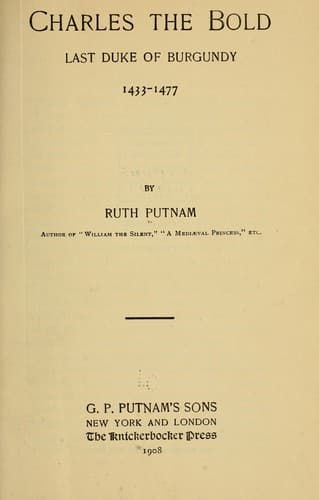
Charles the Bold, Last Duke of Burgundy, 1433-1477Putnam, Ruth
History
Charles the Bold, Last Duke of Burgundy, 1433-1477
Putnam, Ruth
Burgundy (France) -- History; Charles, Duke of Burgundy, 1433-1477; Switzerland -- History -- 1032-1499
"God hathe schewyd Hym selffe marvelouslye lyke Hym that made all
and can undoo agayn whare Hym lyst."[32]
Charles of Burgundy could now pride himself on his foresight. His
brother of the two Orders was himself again.
"The very day on which this fight happened [says Commines] the
Duke of Burgundy, being before Amiens, received letters from
the duchess his wife, that the King of England was not at all
satisfied with him, that he had given his aid grudgingly and as if
for very little cause he would have deserted him. To speak plainly
there never was great friendship between them afterwards. Yet the
Duke of Burgundy seemed to be extremely pleased at this news and
published it everywhere."
A transaction of his own of this time, the duke did not publish. It
was a procedure perhaps justified by these wonderful "mutations in the
world" which impressed Commines as strange and terrible. The Duke of
Burgundy caused a legal document to be drawn up attesting his own
heirship to Henry VI. of England, and filed the same in the Abbey of
St. Bertin with all due formality. If there came more "mutations"
in the world whose very existence was a new experience to Philip de
Commines, Charles was ready to interpose his own plank in the new
structure.
In the archives of the House of Croy in the château of Beaumont, rests
this document, which was duly signed by Charles on November 3, 1471,
in his own hand "so that greater faith" be given to the statement
that no one was truer heir to the Lancaster House than Charles of
Burgundy.[33] Two canons attested the instrument as notaries, and the
witnesses were Hugonet, Humbercourt, and Bladet.
It was expressly stipulated that if there were any delay in the duke's
entering upon his English inheritance--which devolved to him
through his mother,--a delay caused by motives of public utility of
Christendom, and of the House of Burgundy, this should not prejudice
his rights or those of his successors. A mere deferring of assuring
the titles, etc., brought no prejudice to his rights. His delay ended
in his death and Edward IV. never had to combat this claim of the
brother-in-law who had helped him, though grudgingly, to regain his
throne.
[Footnote 1: Meyer is the earliest historian to tell this story and it
is vouched for by no existing contemporary evidence.]
[Footnote 2: From Henry VI.-Henry VII. the English throne was twice
lost and twice regained by each of the rival Houses of York and
Lancaster. Thirteen pitched battles were fought between Englishmen on
English soil. Three out of four kings died by violence. Eighty persons
connected with the blood royal were executed or assassinated.]
[Footnote 3: Ramsay, _Lancaster and York_, ii., 232 _et seq._; Oman,
_Hundred Years' War_ and _Warwick, the King-maker_, are followed here
in addition to Kirk, Lavisse, etc.]
Public-domain text, read in full here on John Shaqi.
Reviews
Reviews
No reviews yet
Be the first to share your thoughts on this work.
Elsewhere in the archive
Join the Discussion
Join the discussion
Sign in to leave a comment or review.
Sign InorCreate an account