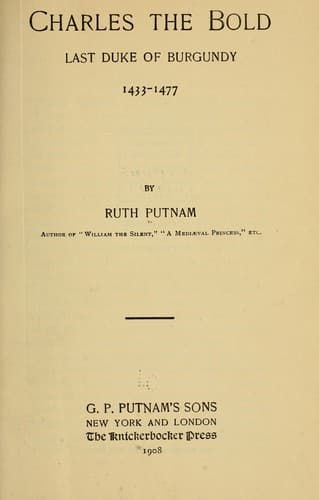
Charles the Bold, Last Duke of Burgundy, 1433-1477Putnam, Ruth
History
Charles the Bold, Last Duke of Burgundy, 1433-1477
Putnam, Ruth
Burgundy (France) -- History; Charles, Duke of Burgundy, 1433-1477; Switzerland -- History -- 1032-1499
[Footnote 31: As soon as Edward and his English exiles sailed, Charles
published a proclamation forbidding his subjects to aid him.]
[Footnote 32: _Letters_, iii., 4.]
[Footnote 33: _See_ Gachard, _Études et Notices historiques concernant
l'histoire des Pays-Bas,_ ii., 343, en approuvant et emologant toutes
les choses deseurdittes et chascune d'icelles et a fin que plus grant
foy soit adjoustée à tout ce que cy desus est escript, avant signé ce
présent instrument de nostre propre main et le fait sceller de nostre
seau en signe de vérité, l'an et jour desusdit. [This in French, the
body in Latin.]
"CHARLES."]
CHAPTER XV
NEGOTIATIONS AND TREACHERY
1471
All work had ceased at Paris for three days by the king's command,
while praise was chanted to God, to the Virgin, and to all saints male
and female, for the victory won by Henry of Lancaster, in 1470, over
the base usurper Edward de la Marche. From Amboise, Louis made a
special pilgrimage to Notre Dame de Celles at Poitiers to breathe in
pious solitude his own prayers of thanksgiving for the happy event.
The battle of Tewkesbury stemmed the course of this abundant stream of
gratitude, and there were other thanksgivings.[1]
In the spring of 1471, Edward IV. was dating complacent letters from
Canterbury to his good friends at Bruges,[2] acknowledging their
valuable assistance to his brother Charles,[3] recognising his part in
restoring Britain's rightful sovereign to his throne. To his sister,
the Duchess of Burgundy, the returned exile gave substantial proof
of his gratitude in the shape of privileges in wool manufacture and
trade.[4]
Like one of the alternating figures in a Swiss weather vane the King
of England had swung out into the open, pointing triumphantly to fair
weather over his head, while Louis was forced back into solitary
impotence. He seemed singularly isolated. His English friends were
gone, his nobles were again forming a hostile camp around Charles of
France, now Duke of Guienne, who had forgotten his late protestations
of fraternal devotion, and there were many indications that the
Anglo-Burgundian alliance might prove as serious a peril to France as
it had in times gone by but not wholly forgotten.
The two most important of the disputed towns on the Somme were,
however, in Louis's possession, and Charles of Burgundy, ready to
reduce Amiens by siege on March 10, 1471, consented to stay his
proceedings by striking a truce which was renewed in July. This
afforded a valuable respite to the king, and he busied himself in
energetic efforts to detach his brother from the group of malcontents.
Various disquieting rumours about the prince's marriage projects
caused his royal brother deep anxiety, and induced him to despatch a
special envoy to Guienne. To that envoy Louis wrote as follows[5]:
"MONSEIGNEUR DU BOUCHAGE:
Public-domain text, read in full here on John Shaqi.
Reviews
Reviews
No reviews yet
Be the first to share your thoughts on this work.
Elsewhere in the archive
Join the Discussion
Join the discussion
Sign in to leave a comment or review.
Sign InorCreate an account