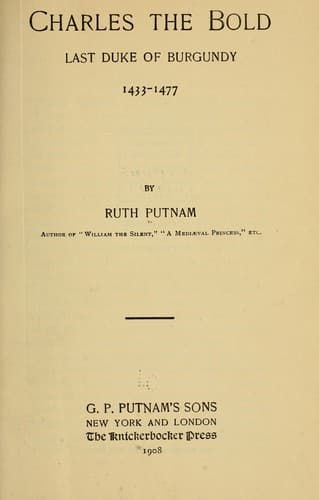
Charles the Bold, Last Duke of Burgundy, 1433-1477Putnam, Ruth
History
Charles the Bold, Last Duke of Burgundy, 1433-1477
Putnam, Ruth
Burgundy (France) -- History; Charles, Duke of Burgundy, 1433-1477; Switzerland -- History -- 1032-1499
"Loys, by the grace of God, King of France. Beloved brother and
cousin, we have received the letters you have written making
mention, as you have heard, that in the truce lately concluded
between us and the Duke of Burgundy up to April 1st next coming,
which will be the year 1473, the Duke of Burgundy has mentioned
you as his ally, which you do not like because you never asked the
Duke of Burgundy to do so, and you do not know whether he made
this statement on the advice of the Venetian ambassador who is
with him.
"Therefore, and because you do not mean to enter into alliance or
understanding with the Duke of Burgundy but wish to remain
our confederate and ally and have sworn to that effect before
notaries, and sealed your oath with your seal ... that you are no
ally of the Duke of Burgundy and that you renounce and repudiate
his nomination as such ... also you may be certain that on our
part we are determined to maintain all friendship between us and
you ... and if we make any treaty in the future we will expressly
include you in it and never will do otherwise."[23]
"Monseigneur the grand master, I am advised how while the truce is
still in being, the Duke of Burgundy has taken Nesle and slain all
whom he found within. I must be avenged for this. I wished you to
know so that if you can find means to do him a like injury in his
country you will do it there and anywhere that you can without
sparing anything. I have good hopes that God will aid in avenging
us, considering the murders for which he is responsible within the
church and elsewhere, and because by virtue of the terms of their
surrender [they thought] they had saved their lives.
"Done at Angers, June 19th.
"P.S.--If the said place had been destroyed and rased as I ordered
this never would have happened. Therefore, see to it that all such
places be rased to the ground, for if this be not done the people
will be ruined and there will be an increase of dishonour and
damage to me."[24]
One fact stated by Louis in this letter was true. Charles of Burgundy
broke the truce when it had but two weeks to run, and thus put
himself in the wrong. The death of Guienne made him wild with anger.
Apparently he had not believed in the imminence of the danger,
although he had been constantly informed of the progress of the
prince's illness. But to his mind, it was the hand of Louis, not the
judgment of God, that ended the life of the prince.
"On the morrow, which was about May 15, 1472, so far as I remember
[says Commines] came letters from Simon de Quingey, the duke's
ambassador to the king, announcing the death of the Duke of
Guienne and that the king had recovered the majority of his
places. Messages from various localities followed headlong one on
the other, and every one had a different story of the death.
Public-domain text, read in full here on John Shaqi.
Reviews
Reviews
No reviews yet
Be the first to share your thoughts on this work.
Elsewhere in the archive
Join the Discussion
Join the discussion
Sign in to leave a comment or review.
Sign InorCreate an account