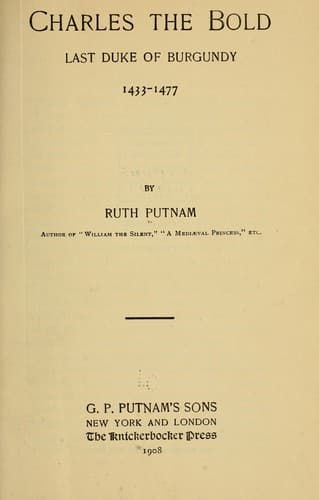
Charles the Bold, Last Duke of Burgundy, 1433-1477Putnam, Ruth
History
Charles the Bold, Last Duke of Burgundy, 1433-1477
Putnam, Ruth
Burgundy (France) -- History; Charles, Duke of Burgundy, 1433-1477; Switzerland -- History -- 1032-1499
With the terrible report of the events at Nesle flying before his
advance guard, Charles went on towards Normandy. Roye he gained
easily, and then, passing by Compiègne where "Monseigneur the grand
master" had intrenched himself, and Amiens with the good burghers whom
Louis delighted to honour, he marched on until he reached Beauvais, an
old town on the Thérain. Some of the garrison from the fallen Roye had
taken refuge there, but the place was weak in its defences, not even
having its usual garrison or cannon, as it happened.
Disappointed in his first expectation of picking the town like a
cherry, Charles sat down before it. The siege that followed won
a reputation beyond the warrant of its real importance from the
extraordinary tenacity and energy of the people in their own defence.
Every missile that the ingenuity of man or woman could imagine was
used to drive back the besiegers when the town was finally invested.
From June 27th to July 9th Charles waited, then an assault was
ordered. Charles laughed at the idea of any serious resistance. "He
asked some of his people whether they thought the citizens would wait
for the assault. It was answered yes, considering their number even if
they had nothing before them but a hedge."[28] He took this as a joke
and said, "To-morrow you will not find a person." He thought that
there would be a simple repetition of his experience at Dinant and
Liege, and that the garrison would simply succumb in terror. When the
Burgundians rushed at the walls their reception showed not only that
every point had a defender, but also that those same defenders were
provided with huge stones, pots of boiling water, burning torches--all
most unpleasant things when thrown in the faces of men trying to scale
a wall. Three hours were sufficient to prove to the assailants the
difficulty of the task. Twelve hundred were slain and maimed, and the
strength of the place was proven.
Charles was not inclined to relinquish his scheme, but the weather
came to the aid of the besieged. Heavy rains forced the troops to
change camp. More men were lost in skirmishes and mimic assaults,
losses that Charles could ill afford at the moment. Finally at the end
of three fruitless weeks, the siege was raised and the Burgundians
marched on to try to redeem their reputation in Normandy. Had Beauvais
fallen, it would have been possible to relieve the Duke of Brittany,
against whom Louis had marched with all his forces and whom he had
enveloped as in a net. This reverse was the first serious rebuff that
had happened to Charles, and it marked a turn in his fortunes.
Public-domain text, read in full here on John Shaqi.
Reviews
Reviews
No reviews yet
Be the first to share your thoughts on this work.
Elsewhere in the archive
Join the Discussion
Join the discussion
Sign in to leave a comment or review.
Sign InorCreate an account