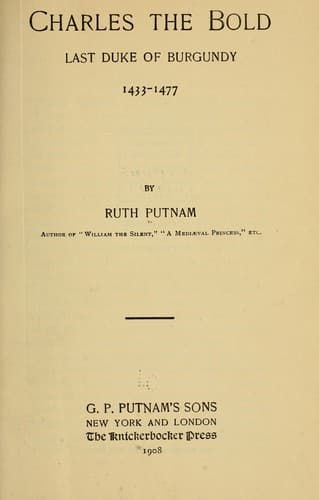
Charles the Bold, Last Duke of Burgundy, 1433-1477Putnam, Ruth
History
Charles the Bold, Last Duke of Burgundy, 1433-1477
Putnam, Ruth
Burgundy (France) -- History; Charles, Duke of Burgundy, 1433-1477; Switzerland -- History -- 1032-1499
[Footnote 25: Odet d'Aydie, whom Louis had hoped to have converted to
his cause, was the man to spread the charge against Louis broadcast
over the land. The truth of the death is not proven. Frequent mentions
of Guienne's condition occur through the letters of the winter '71-72.
The story was that the poison, administered subtly by the king's
orders, caused the illness of both the prince and his mistress, Mme.
de Thouan. She died after two months of suffering, December 14th,
while he resisted the poison longer, though his health was completely
shattered and his months of longer life were unutterably wretched and
painful, a constant torture until death mercifully released him in
May. Accusations of poisoning are often repeated in history. In this
case, there was certainly a wide-spread belief in Louis's guilt. In
his manifestos, (Lenglet, ii., 198) Charles declares that the king's
tools in compassing his brother's death were a friar, Jourdain Favre,
and Henri de la Roche, esquire of his kitchen.
The story told by Brantôme _(OEuvres Complètes_ de Pierre de
Bourdeille, Seigneur de Brantôme, ii., 329. "Grands Capitaines
Francois." There is nothing too severe for Brantôme to say about Louis
XI.) is very detailed. A fool passed to Louis's service from that of
the dead prince. While this man was attending his new master in the
church of Notre Dame de Cléry, he heard him make this prayer to the
Virgin: "Ah! my good Lady, my little mistress, my great friend in whom
I have always put my trust, I pray thee be a suppliant to God in my
behalf, be my advocate with Him so that He may pardon me for the death
of my brother whom I had poisoned by this wicked Abbé of St. John. I
confess it to thee as to my good patron and mistress. But what was to
be done? He was a torment to my realm. Get me pardoned and I know well
what I will give thee."
Brantôme tells further that the fool, using the privilege of free
speech accorded to his class, talked about Guienne's death at dinner
in public and after that day was never seen again. On the other hand,
the young duke's will was all to his brother's favour. Louis was
made executor and legatee, "and if we have ever offended our beloved
brother," dictated the dying man, "we implore him to pardon us as we
with _débonnaire_ affection pardon him." Mandrot, editor of Commynes
(1901), i., 230, considers the whole story a malicious fabrication of
Odet d'Aydie, and other authorities refer the cause to disease. The
very date of the death varies from May 12th to May 24th.]
[Footnote 26: Commines, iii., ch. ix.]
[Footnote 27: There is a curious document in existence (see _Bulletins
de L'Hist. de France_, 1833-34) dated fifty years after the event. It
is the deposition of several old people who had been just old enough
to remember that awful experience of their youth. Fifty years of
repetition gave time for the growth of the story.]
[Footnote 28: Commines, iii., ch. x.]
Public-domain text, read in full here on John Shaqi.
Reviews
Reviews
No reviews yet
Be the first to share your thoughts on this work.
Elsewhere in the archive
Join the Discussion
Join the discussion
Sign in to leave a comment or review.
Sign InorCreate an account