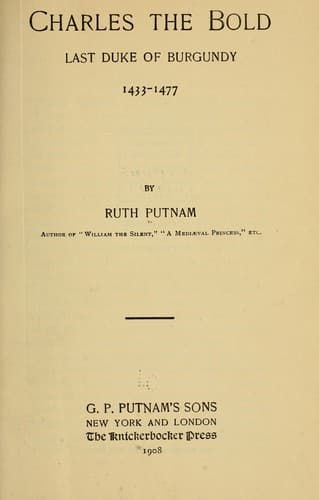
Charles the Bold, Last Duke of Burgundy, 1433-1477Putnam, Ruth
History
Charles the Bold, Last Duke of Burgundy, 1433-1477
Putnam, Ruth
Burgundy (France) -- History; Charles, Duke of Burgundy, 1433-1477; Switzerland -- History -- 1032-1499
Indignant remonstrances against this conduct were heard from various
quarters, and were all alike unheeded by the young duke until Charles
of Burgundy interfered and ordered him to bring his father to his
presence, and to submit the dispute to his arbitration. Charles was
too near and too powerful a neighbour to be disregarded, and his
peremptory invitation was accepted. Pending the decision, the
two dukes were forced to be guests in his court, under a strict
surveillance which amounted to an arrest.
The first suggestion made by Charles was for a compromise between
father and son. "Let Duke Arnold retain the nominal sovereignty in
Guelders, actual possession of one town, and a fair income, while
to Adolf be ceded the full power of administration." The latter was
emphatic in his refusal to consider the proposition. "Rather would I
prefer to see my father thrown into a well and to follow him thither
than to agree to such terms. He has been sovereign duke for forty-four
years; it is my turn now to reign." Arnold thought it would be a
simple feat to fight out the dispute. "I saw them both several times
in the duke's apartment and in the council chamber when they pleaded,
each his own cause. I saw the old man offer a gage of battle to his
son."[1] The senior belonged to the disappearing age of chivalry. A
trial of arms seemed to him an easy and knightly fashion of ending his
differences with his importunate heir.
No settlement was effected before the French expedition, but Charles
was not disposed to let the matter slip from his control, and when
he proceeded to Amiens, the two dukes, still under restraint, were
obliged to follow in his train. At a leisure moment Charles intended
to force them to accept his arbitration as final. Before that moment
arrived, the more agile of the two plaintiffs, Adolf, succeeded in
eluding surveillance and escaping from the camp at Wailly. He made his
way successfully to Namur disguised as a Franciscan monk. Then, at
the ferry, he gave a florin when a penny would have sufficed. The
liberality, inconsistent with his assumed rôle, aroused suspicion and
led to the detection of his rank and identity. He was stayed in his
flight and imprisoned in the castle of Namur to await a decision on
his case by his self-constituted judge. This was not pronounced until
the summer of 1473.
By that time, Charles was resolved on another course of action than
that of adjusting a family dispute in the capacity of puissant,
impartial, and friendly neighbour. Adolf's behaviour towards his
father had been extraordinarily brutal and outrageous. Public comment
had been excited to a wide degree. It was not an affair to be dealt
with lightly by Duke Charles. The young Duchess of Guelders was
Catharine of Bourbon, sister to the late Duchess of Burgundy, and
Adolf himself was chevalier of the Golden Fleece. In consideration of
these links of family and knightly brotherhood, Charles desired that
the case should be tried with all formality.
Public-domain text, read in full here on John Shaqi.
Reviews
Reviews
No reviews yet
Be the first to share your thoughts on this work.
Elsewhere in the archive
Join the Discussion
Join the discussion
Sign in to leave a comment or review.
Sign InorCreate an account