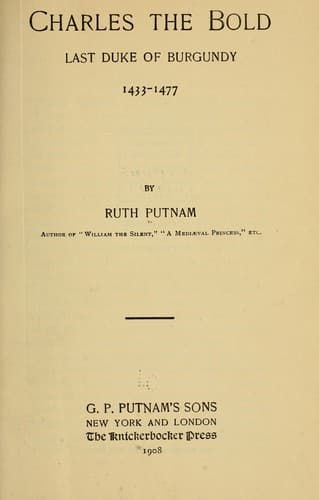
Charles the Bold, Last Duke of Burgundy, 1433-1477Putnam, Ruth
History
Charles the Bold, Last Duke of Burgundy, 1433-1477
Putnam, Ruth
Burgundy (France) -- History; Charles, Duke of Burgundy, 1433-1477; Switzerland -- History -- 1032-1499
When Sigismund of Austria completed his mortgage, in 1469, at St.
Omer, and returned home, as already stated, he was fired with zeal to
divert some of the dazzling Burgundian wealth into the empty imperial
coffers. An alliance between Mary of Burgundy and the young Archduke
Maximilian seemed to him the most advantageous matrimonial bargain
possible for the emperor's heir. He urged it upon his cousin with
all the eloquence he possessed, and was lavish in his offers to be
mediator between him and his new friend Charles.
Frederic was impressed by Sigismund's enthusiastic exposition of the
advantages of the match, and little time elapsed before his ambassador
brought formal proposals to Charles for the alliance. The duke
received the advances complacently and returned propositions
significant of his personal ambitions. As early as May, 1470, his
instructions to certain envoys sent to the intermediary, Sigismund,
are plain. In unequivocal terms, his daughter's hand is made
contingent on his own election as King of the Romans, that shadowy
royalty which veiled the approach to the imperial throne.
"_Item_--And in regard to the said marriage, the ambassadors shall
inform Monseigneur of Austria that, since his departure from
Hesdin, certain people have talked to Monseigneur about this
marriage and mentioned that, in return, the emperor would be
willing to grant to Monseigneur the crown and the government of
the Kingdom of the Romans, with the stipulation that Monseigneur,
_arrived at the empire by the good pleasure of the emperor_ or
by his death, would, in his turn, procure the said crown of the
Romans for his son-in-law. The result will be that the empire
will be continued in the person of the emperor's son and his
descendants.
"_Item_--They shall tell him about a meeting between the imperial
and ducal ambassadors, at which meeting there was some talk of
making a kingdom out of certain lands of Monseigneur and
joining these to an _imperial_ vicariate of all the lands and
principalities lying along the Rhine."
In the following paragraphs of this instruction,[7] Charles directs
his envoys to make it clear to Monseigneur of Austria (Sigismund)
that the duke's interest in the plan does not spring from avarice or
ambition. He is purely actuated by a yearning to employ his time and
his strength for God's service and for the defence of the Faith, while
still in his prime.
Public-domain text, read in full here on John Shaqi.
Reviews
Reviews
No reviews yet
Be the first to share your thoughts on this work.
Elsewhere in the archive
Join the Discussion
Join the discussion
Sign in to leave a comment or review.
Sign InorCreate an account