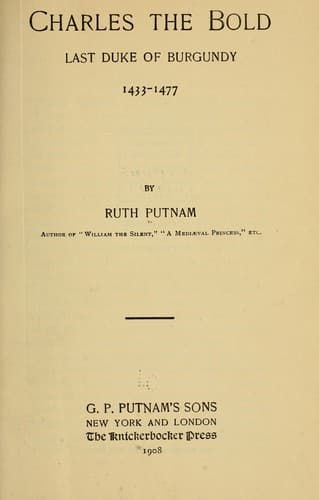
Charles the Bold, Last Duke of Burgundy, 1433-1477Putnam, Ruth
History
Charles the Bold, Last Duke of Burgundy, 1433-1477
Putnam, Ruth
Burgundy (France) -- History; Charles, Duke of Burgundy, 1433-1477; Switzerland -- History -- 1032-1499
As the two princes rode together into the city, Charles's
accoutrements attracted all eyes. The polished steel of his armour
shone like silver. Over it hung a short mantle actually embroidered
with diamonds and other precious stones to the value of two hundred
thousand gold crowns. His velvet hat, graciously held in his hand out
of compliment to the emperor, was ornamented with a diamond whose
price no man could tell. Before him walked a page carrying his helmet
studded with gems, while his magnificent black steed was heavily
weighted down with its rich caparisons.
Frederic III., very simple in his ordinary dress, had exerted himself
to appear well to his great vassal. His robe of cloth of gold
was fine, though it may have looked something like a luxurious
dressing-gown, as it was made after the Turkish fashion and bordered
with pearls. The emperor was lame in one foot, injured, so ran the
tradition, by his habit of kicking, not his servants, but innocent
doors that chanced to impede his way.
The Archduke Maximilian, gay in crimson and silver, walked by the side
of an Ottoman prince, prisoner of war, and converted to Christianity
by the pope himself. And then there was a host of nobles, great and
small. Among them were Engelbert of Nassau[3] and the representative
of the House of Orange-Châlons, whose titles were destined to be
united in one person within the next half-century.
The magnificence remained unrivalled in the history of royal
conferences. The very troopers wore habits of cloth of gold over their
steel, while their embroidered saddle-cloths were fringed with silver
bells. Surpassing all others, were the heralds-at-arms of the various
individual states which acknowledged Charles as their sovereign,
seigneur, count, or duke as the case might be. They preceded their
liege lord, clad in their distinctive armorial coats, ablaze with
colour. Before them were the trumpeters in white and blue, their very
instruments silvered, while first of all rode one hundred golden
haired boys, "an angel throng."
It was so difficult to decide as to the requisite etiquette of escort,
that the emperor and duke agreed to separate on the fairly neutral
ground of the market-place. Each proceeded with his own suite to his
lodgings, Frederic to the archbishop's palace, and Charles to
the abbey of St. Maximin, which had conferred on him, some years
previously, the honorary title of "Protector." His army was quartered
within and without the city. Two days for repose and then the first
official interview took place, which is described as follows, by an
unknown correspondent, evidently in the ducal suite:[4]
Public-domain text, read in full here on John Shaqi.
Reviews
Reviews
No reviews yet
Be the first to share your thoughts on this work.
Elsewhere in the archive
Join the Discussion
Join the discussion
Sign in to leave a comment or review.
Sign InorCreate an account