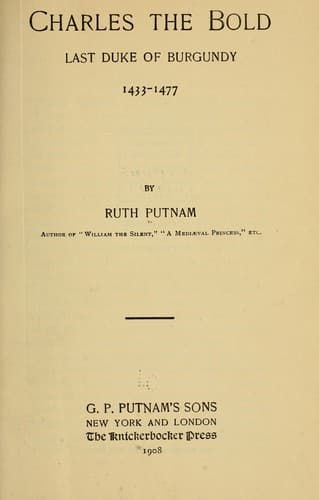
Charles the Bold, Last Duke of Burgundy, 1433-1477Putnam, Ruth
History
Charles the Bold, Last Duke of Burgundy, 1433-1477
Putnam, Ruth
Burgundy (France) -- History; Charles, Duke of Burgundy, 1433-1477; Switzerland -- History -- 1032-1499
The chief members were Basel, Colmar, Mulhouse, Schlestadt, and two
dioceses, and it is referred to as the _Basse-Union_ or the Lower
Union, the purposes being to guarantee mutually the rights of the
contracting parties, to meet for discussion on various questions, and,
specifically, to help Mulhouse pay her debts. A few days later, March
19th, there was a fresh proposition to make an alliance between
this _Basse-Union_ and the Swiss confederation. This required a
_referendum_. Each Swiss delegate received a copy of the articles to
take back to his constituents for their consideration. No bond between
the confederation and the union was, however, in existence at the time
when Charles was approaching Alsace. Various conciliatory measures
on his part had somewhat lessened immediate opposition to him, but,
nevertheless, there were frequent conferences about affairs. Diets
were almost continuous and there were strenuous efforts to raise money
to free Mulhouse from her hampering financial embarrassments.
Hagenbach had not followed up his threats of immediate war measures,
but it was known that he had obtained imperial authorisation to
assume the jurisdiction of Mulhouse, a step which her allies hoped to
forestall by settling her debts. Strasburg offered to contribute six
hundred florins, Berne and Soleure seven hundred, Basel four hundred,
while Colmar, Schlestadt, Obernai, and Kaisersberg together hoped to
raise another four hundred. A diet was called at Basel for December
11th, and Zürich and Lucerne were expected to enter into the union.
The tidings of the duke's approach were undoubtedly a stimulus to
these renewed efforts to make the league strong enough to withstand
him. The sentiment expressed by the pious Knebel, "May God protect us
from his mighty hand," voiced probably a wide-spread dread.
When Charles entered Alsace, his escort was large enough to
inspire fear, but there was no opposition to his advance, though
consultations, now at one city, now at another, were frequent. The
duke paid little heed to their deliberations, under-estimating their
importance, while he was gracious to any words of welcome offered to
him. Strasburg sent him greetings while he rested at Châtenois, and so
did Colmar. The latter town expressed her willingness to receive him
and an escort of one or two hundred, but was firm in her refusal to
admit a larger force within her walls. By this precaution, Charles was
baffled in his plot to gain possession of the town, and so passed on
his way.
On Christmas eve, the traveller made a formal entry into Brisac, where
a temporary court was established, and where audience was given to
various embassies with the customary Burgundian pomp. Meanwhile the
troops, forced to camp without the walls, were a burden to the land,
and seem to have been more odious than usual to their unwilling hosts.
Public-domain text, read in full here on John Shaqi.
Reviews
Reviews
No reviews yet
Be the first to share your thoughts on this work.
Elsewhere in the archive
Join the Discussion
Join the discussion
Sign in to leave a comment or review.
Sign InorCreate an account