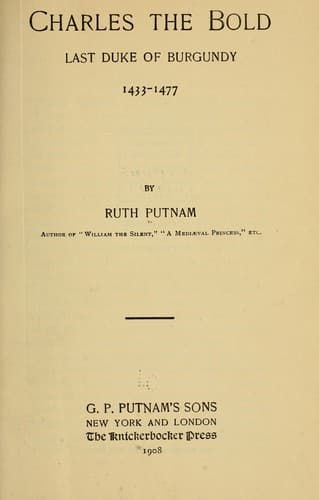
Charles the Bold, Last Duke of Burgundy, 1433-1477Putnam, Ruth
History
Charles the Bold, Last Duke of Burgundy, 1433-1477
Putnam, Ruth
Burgundy (France) -- History; Charles, Duke of Burgundy, 1433-1477; Switzerland -- History -- 1032-1499
Hagenbach lost no time in proceeding to the levying of the impost now
approved by the duke, who had at the same time expressly ordered that
the people were to be treated mildly, and that summary punishment
was to check all excesses on the part of the eight hundred Picards
employed by Hagenbach to aid the tax collector. The governor, however,
saw no further need for gentle treatment or for respect to privileges.
In Brisac, municipal elections were arbitrarily set aside, and
officers appointed by the governor. The corporation was curtailed
of power, and the burghers were forced to prepare to march against
Mulhouse.
Having accomplished his duty to his own satisfaction, Hagenbach
proceeded to give himself some relaxation. His own marriage took place
on January 24th, and he celebrated the occasion with great fêtes. It
is of this period in Hagenbach's life that the stories of gross excess
are told.[12] It seems as though, having once abandoned restraint
towards the city, his personal passions, too, were permitted to run
riot, and he spared no wife nor maid to whom he took a fancy.
As he had succeeded in impressing the "Bad Penny" on the little
independent landowners, he tried to extend it to the territory of the
Bishop of Basel. Vehement was the opposition which was reported to the
duke, who promptly ordered his lieutenant to restore the prisoners he
had taken and to cease his aggressions. Charles was not ready to
meet the Swiss, and was willing to defer an issue, but he was wholly
ignorant of the real strength of the confederation. Hagenbach then
proceeded to make a stronghold of Brisac and waited for further
action.
[Footnote 1: De Roye, p. 105.]
[Footnote 2: He also issued administrative orders. It was at this time
that he instituted a high court of justice and a chamber of accounts
at Mechlin, both designed to serve for all the Netherland provinces.
This measure was bitterly resented by the local authorities.
(Fredericq. _Le rôle politique et social des ducs de Bourgogne_, p.
183.)]
[Footnote 3: Letters are preserved in the Cologne archives. (Toutey,
p. 64.)]
[Footnote 4: Toutey, p. 66. This document is in the Cologne archives.]
[Footnote 5:_See_ Toutey, p. 66. These are printed in Lacomblet,
_Urkunden_, iv., 468, 470.]
[Footnote 6: Jean de Roye is the only contemporary to tell this story.
Both Toutey and Kirk reject it. (_See_ Toutey, p. 76; Kirk, ii.,
271.)]
[Footnote 7: Toutey's suggestion.]
[Footnote 8: All sons inherited their father's title, so that there
were many landless lords.]
[Footnote 9: At this period there were eight in the confederation,
which was a loose structure in which each member preserved her
individuality.]
[Footnote 10: _See_ Toutey, p. 82, who quotes from the _Cartulaire de
Mulhouse_, iv., _et passim_. This last furnishes the details for these
passages.]
Public-domain text, read in full here on John Shaqi.
Reviews
Reviews
No reviews yet
Be the first to share your thoughts on this work.
Elsewhere in the archive
Join the Discussion
Join the discussion
Sign in to leave a comment or review.
Sign InorCreate an account