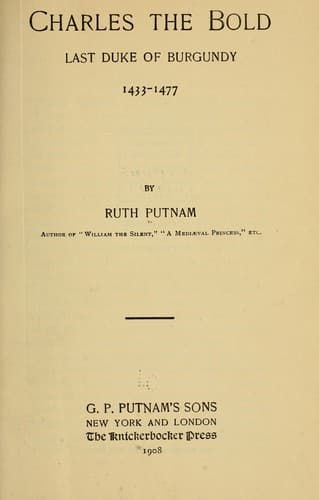
Charles the Bold, Last Duke of Burgundy, 1433-1477Putnam, Ruth
History
Charles the Bold, Last Duke of Burgundy, 1433-1477
Putnam, Ruth
Burgundy (France) -- History; Charles, Duke of Burgundy, 1433-1477; Switzerland -- History -- 1032-1499
Charles did not hasten to Alsace to settle matters in person, but
pursued his intention of reducing Cologne to the archbishop's control,
undoubtedly thinking that the base which would then be open to the
archbishop's protector on the lower Rhine would facilitate his
operations in the upper valleys. Meanwhile the Emperor Frederic had
emphatically declared that he alone was the Defender of the Diocese,
and that the unholy alliance between Robert and Charles was a menace
to the empire. His letters to Charles exhorted him to abandon the
enterprise and to accept mediation; those to the electors, princes,
and cities of the empire urged them to defend Cologne against Burgundy
until he himself arrived on the scene. There was a hot correspondence
between all parties concerned, from which nothing resulted. Charles
had various reasons for delay. There was trouble in other quarters of
his domain. Flanders was in a state of ferment at his requisitions
for money, and the Franche-Comté was on the point of making active
resistance to the imposition of the _gabelle_.
In view of all these complications, Charles decided to prolong his
truce with Louis XI., to May 1, 1475. That monarch was well pleased
to continue to pursue his own plans under cover of neutrality. The
determination of the anti-Burgundian coalition in Germany to keep
Charles within the limits of his own estates was a pleasant sight to
the French king, and he felt that he could afford to wait.
In June an edict was sent forth from Luxemburg, forbidding all owing
allegiance to the Duke of Burgundy to have any commercial relations
with the rebels of Cologne, or of Alsace, or with the cities of the
_Basse Union_, and declaring the duke's intention to take the field
at once, to reinstate the archbishop in his rightful see. This was a
declaration of war and was speedily followed by the duke's advance
to Maestricht, where he spent a few days in July, collecting a force
which finally amounted to about twenty thousand men.
On the 29th he sat down before Neuss, which had again emphatically
refused entry to him and his troops. Three days the duke gave himself
for the reduction of the town, but there he remained encamped for
nearly a whole year! Neuss was resolved to resist to the last
extremity, while Bonn, Andernach, and Cologne contributed their
assistance by worrying and harassing the besiegers to the best of
their ability. It was a period when Charles seemed to have only one
sure ally, and that was Edward of England, whose own plans were
forming for a mighty enterprise--no less than a new invasion of
France.
Public-domain text, read in full here on John Shaqi.
Reviews
Reviews
No reviews yet
Be the first to share your thoughts on this work.
Elsewhere in the archive
Join the Discussion
Join the discussion
Sign in to leave a comment or review.
Sign InorCreate an account