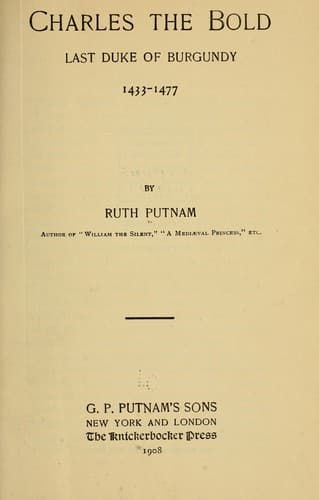
Charles the Bold, Last Duke of Burgundy, 1433-1477Putnam, Ruth
History
Charles the Bold, Last Duke of Burgundy, 1433-1477
Putnam, Ruth
Burgundy (France) -- History; Charles, Duke of Burgundy, 1433-1477; Switzerland -- History -- 1032-1499
The expedition proved a wretched failure--a miserable disappointment
to the English at home, who had been lavish in their contributions.
Charles seems to have been put out by the place of landing. His own
plan is clear from the letter quoted. He wished the two armies of
Edward and himself to sweep a large stretch of territory as they
marched toward each other. The one thing that he objected to was a
consolidation of the two forces. Incapacity to turn an unexpected or
an unwelcome situation to account was one of the duke's most
deeply ingrained characteristics. He showed no inventiveness or
resourcefulness. He held his own army at a distance from the English,
much to the invader's chagrin, who was forced to march unaided over
regions rendered inhospitable by Louis's stern orders, and outside
of cities ready to hold him at bay. "If you do not put yourself in a
state of security, it will be necessary to destroy the city, to our
regret," was the king's message to Rheims, and the most skilful of
French engineers was fully prepared to make good the words.
Open hostilities were avoided. Edward camped on the field of
Agincourt, where perhaps he dreamed of his ancestor's success, but
no fresh blaze of old English glory illumined his path. He did not
proceed to Paris, there was no coronation at Rheims, no comfortable
reception within any gates at all, for Charles was as chary as Louis
himself of giving the English a foothold, though he advised Edward to
accept an invitation from St. Pol to visit St. Quentin. This, however,
proved another disappointment. Just as Edward was ready to enter,
the gates opened to let out a troop which effectually repulsed the
advancing foreigners. The Count of St. Pol had changed his mind.
"It is a miserable existence this of ours when we take toil and
trouble enough to shorten our life, writing and saying things exactly
opposite to our thoughts," writes the keenest observer of this
elaborate network of pompous falsehoods[6] wherein every action was
entangled. Louis XI trusted no one but himself, while he played
with the trust of all, and his game was the safest. His fear of the
invaders was soon allayed. "These English are of different metal from
those whom you used to know. They keep close, they attempt nothing,"
he wrote to the veteran Dammartin.
Public-domain text, read in full here on John Shaqi.
Reviews
Reviews
No reviews yet
Be the first to share your thoughts on this work.
Elsewhere in the archive
Join the Discussion
Join the discussion
Sign in to leave a comment or review.
Sign InorCreate an account