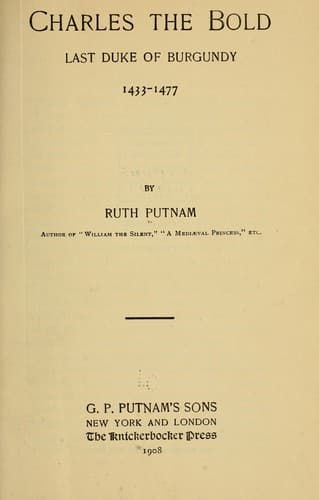
Charles the Bold, Last Duke of Burgundy, 1433-1477Putnam, Ruth
History
Charles the Bold, Last Duke of Burgundy, 1433-1477
Putnam, Ruth
Burgundy (France) -- History; Charles, Duke of Burgundy, 1433-1477; Switzerland -- History -- 1032-1499
There was a short period of hesitation, marked by a truce till January
1, 1476, between Charles and the confederates, a period when the timid
among the allies urged their counsel of reconciliation at all hazards.
Charles, too, seems to have desired an accord rather than hostilities,
even though he still bore the Swiss a bitter grudge for Héricourt. It
was probably appeals from Yolande of Savoy that decided him to open a
campaign in midwinter.
"The prince has been so busy for a week past [wrote the Milanese
ambassador] in the reorganisation of his army according to new
ordinances, and in the regulation of his receipts and outlays that
he has scarcely given himself time to eat once in twenty-four
hours. He is importuned by the Duchess of Savoy and the Count of
Romont for aid against the Swiss who respect no treaty, and do
not cease increasing their forces. In consequence, Duke Charles
intends leaving Nancy in six days to go towards the Jura. He
expects to take with him 2300 lances and 10,000 ordnance, which,
joined to the feudal militia of Burgundy and Savoy, will swell his
army to the number of 25,000 combatants. His operations are so
planned that he will have more to gain than to lose."[13]
When Charles left Nancy on January 11th, he issued one of his
grandiloquent manifestoes declaring that he was acting in behalf of
all princes and seigneurs who had suffered wrong at the hands of the
Swiss, and that he was ready to punish all who had provoked his just
wrath by ravaging his province of Burgundy. It was rather a curious
act on his part, to let his chief mercenary captain go off to make a
pilgrimage just as he was on the eve of a campaign, but so he did,
granting Campobasso leave of absence to visit the shrine of St. James
at Compostella, a leave possibly utilised by the Italian to further
the understanding with Louis XI., at which he arrived later.
On across the Jura marched the Burgundian army, while the Swiss diet
came to a slow and confused decision to prepare to meet him. He did
not take the route generally expected, directly towards Berne, his
chief antagonist, but turned aside and attacked the little fortress of
Granson. The castle was not over strong. Efforts to provision it by
water failed, and, finally, on February 28th, after a brief siege, the
captain of the garrison, Hans Wyler, capitulated to the duke's German
forces, who represented to them that Charles was as generous as he was
magnificent.
Public-domain text, read in full here on John Shaqi.
Reviews
Reviews
No reviews yet
Be the first to share your thoughts on this work.
Elsewhere in the archive
Join the Discussion
Join the discussion
Sign in to leave a comment or review.
Sign InorCreate an account