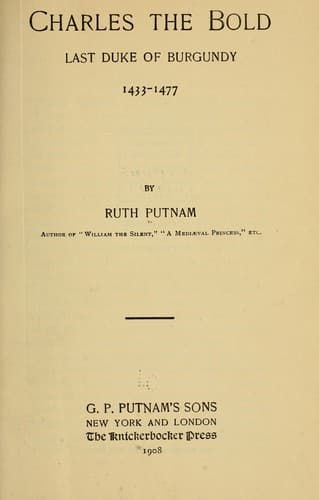
Charles the Bold, Last Duke of Burgundy, 1433-1477Putnam, Ruth
History
Charles the Bold, Last Duke of Burgundy, 1433-1477
Putnam, Ruth
Burgundy (France) -- History; Charles, Duke of Burgundy, 1433-1477; Switzerland -- History -- 1032-1499
This plain-spoken epistle failed to reach its destination until after
the prophecy had been fulfilled. Its warning would probably have been
futile had Charles read it before he marched on towards Berne, on June
8th. On the road that he chose lay the town of Morat, which had made
ready for his approach. A few days to reduce it, and then on to Berne
was his plan. His force succeeded in holding the ground and cutting
off communication with Berne for three days. On the 14th, a messenger
made his way through from the beleaguered city to Berne, and all the
allies were then urged to do their best. The result was encouraging.
"There are three times as many as at Granson, but let no one be
dismayed, with God's help we will kill them all," wrote a leader of
Berne.
The encounter came on June 23d. The force was really a formidable one.
René of Lorraine was among the commanders on the side of the Swiss.
It was a tremendous fight, brief as it was savage; at two o'clock the
assault was made and within an hour Charles was repulsed. Almost all
the infantry perished. The slain is estimated variously from ten
to twenty-two thousand. Charles did not keep his vow to perish if
defeated. To his assured allies he clung closely, and none had more
reason to be faithful to him than Yolande of Savoy. After Granson he
hastened to give the duchess his own view of the disaster:
"It has given me a singular pleasure to hear of your calmness and
constancy of soul; for the thought of your affliction weighed more
heavily upon me than what has befallen me ... every day diminishes
the inconvenience and proves that the loss in men is less than we
thought. _Such as it is it came from a mere skirmish_. The bulk
of the armies did not engage, to my great displeasure. Had they
fought the victory would have been mine. There has been none on
either side. God, I trust, reserves it for you and for me ... the
hope you have placed in me shall not be vain."
Thus he wrote on March 7th to encourage his anxious protégée.
[Illustration: A PLAN OF THE BATTLE OF MORAT]
After the second defeat it was to her that the duke turned again. In
the very early morning after the battle of Morat, Charles paused at
Morges on the Lake of Geneva, having ridden hard through the night.
There he heard mass, breakfasted, rested awhile, and then rode on,
reaching the castle of Gex at six o'clock in the evening, where
Yolande of Savoy was awaiting his coming in full knowledge of the
second disaster he had suffered.
Public-domain text, read in full here on John Shaqi.
Reviews
Reviews
No reviews yet
Be the first to share your thoughts on this work.
Elsewhere in the archive
Join the Discussion
Join the discussion
Sign in to leave a comment or review.
Sign InorCreate an account