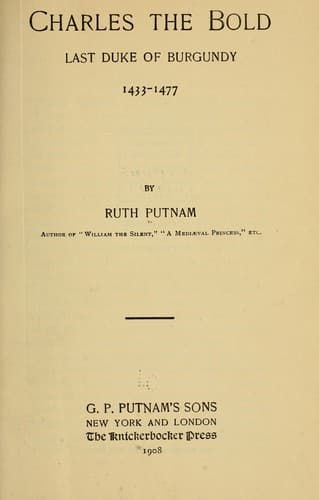
Charles the Bold, Last Duke of Burgundy, 1433-1477Putnam, Ruth
History
Charles the Bold, Last Duke of Burgundy, 1433-1477
Putnam, Ruth
Burgundy (France) -- History; Charles, Duke of Burgundy, 1433-1477; Switzerland -- History -- 1032-1499
There was evidently a hope that better results might be obtained from
a new assembly,[5] but none was held and the most earnest endeavours
of the duke's wife and daughter failed to arouse enthusiasm for his
plans. Moreover, when there seemed a prospect that the Netherlands
might be attacked from France, the sympathy of even the duchess and
council for offensive operations was chilled. Not only did Margaret
fail to send her husband the extra supplies demanded, but she decided
to appropriate the three months' subsidy, the chief item of regular
ducal revenue, for protection of the Flemish frontier--an action that
made Charles very angry. Defences at home! Yes, indeed, they were
necessary, but the people must provide them. The subsidy was lawfully
his and he needed every penny of it. His army had not been destroyed.
He was simply obliged to strengthen it. Burgundy was helping him.
Flanders must do her part. They were deaf to this appeal, although a
generous message was sent saying that if he were hard pressed they
would go in person to rescue him from danger.
The story of the assembly of the Estates of the two Burgundies is
equally interesting as a picture of the clash between sovereign will
and popular unreadiness to open the carefully guarded money-boxes.[6]
The deputies convened at Salins on July 8th, in the presence of the
duke himself. The session was opened by Jean de Grey, the president
of the _parlement_ of the duchy, with a brief statement of the
sovereign's needs. Then Charles took the floor, and delivered a
tremendous harangue with a marvellous command of language. Panigarola
declared that his allusions to parallel crises in ancient times were
so apt and so fluent that it seemed as though the book of history lay
opened before him and that he read from its pages.[7] The impression
he made was plain to see.
[Illustration: BATTLE OF NANCY CONTEMPORANEOUS MINIATURE IN ABBEY OF
ST. GERMAIN DES PRÉS (COMINES-LENGLET, III.)]
His demands for aid to retrieve the Swiss disasters were open and
aboveboard this time. There was no such pretence put forward as the
escort of Mary. The argument was that any ruler, backed by his people
unanimous in their willingness to give their last jewel for public
purposes, must inevitably succeed in his righteous wars, etc.
Public-domain text, read in full here on John Shaqi.
Reviews
Reviews
No reviews yet
Be the first to share your thoughts on this work.
Elsewhere in the archive
Join the Discussion
Join the discussion
Sign in to leave a comment or review.
Sign InorCreate an account