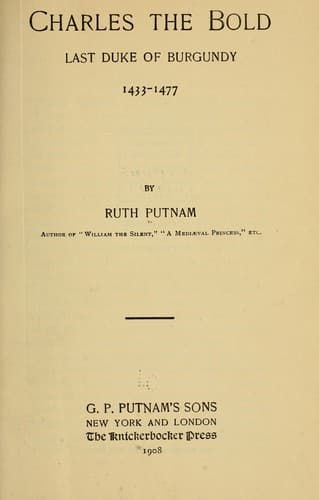
Charles the Bold, Last Duke of Burgundy, 1433-1477Putnam, Ruth
History
Charles the Bold, Last Duke of Burgundy, 1433-1477
Putnam, Ruth
Burgundy (France) -- History; Charles, Duke of Burgundy, 1433-1477; Switzerland -- History -- 1032-1499
Charles was absolutely deaf to these arguments. He was determined on
facing the issue at once. Leaving a small force to sustain the siege,
he ordered the camp to be broken on the evening of the 4th and a
movement made towards St.-Nicolas. He selected a ground favourable
for the manipulation of a large body, and placed his artillery on a
plateau situated between Jarville and Neuville. It was not a good
position, being hedged in on the right and in front by woods which
could conceal the movements of a foe without impeding them. Only one
way of retreat was open--towards Metz, whose bishop was Charles's
last ally. But to reach Metz, it was necessary to cross several small
streams and deceptive marshes, half frozen as they were, besides the
river Meurthe, a serious obstacle with the garrison of Nancy on the
flank. In short, there was ample reason to dread surprise, while
in case of defeat a terrible catastrophe was more than possible.
Curiously, the precise kind of difficulties which beset the field of
Morat were repeated here--proof that Charles had not the qualities of
a general who could learn by experience.[16]
The exact force at his disposal on this occasion has been variously
estimated. Considering the ravages of the sanguinary skirmishes during
the siege, and of the cold, it is probable that the actual combatants
did not number more than ten thousand, all told. And only half of
these were of any value--two thousand men under Galeotto, and
three thousand Burgundians commanded by Charles and his immediate
lieutenants. The remainder were unreliable mercenaries and the still
more unreliable troops of Campobasso already pledged to the foe. La
Marche estimates René's force at twelve thousand and adds: "The Duke
of Burgundy was far behind, for, on my conscience, he had not two
thousand fighting men."[17]
The allies adopted a plan of battle proposed by a Lorrainer, Vautrin
Wuisse. The first manoeuvre was to divert the foe and turn him towards
the woods, and then to attack his centre, which would at the same
time be pressed at the front by the Lorraine forces, headed by René
himself. The plan succeeded in every point. Surprised that they dared
take the offensive, Charles was alert to the harsh cries of the "bull"
of Uri and the "cow" of Unterwalden, which were heard across the
woods. A sudden presentiment saddened him. Putting on his helmet, he
accidentally knocked off the lion bearing the legend _Hoc est signum
Dei_. He replaced it and plunged into the mêlée.
The onslaught was terrific. Galeotto's troops and the duke's were the
only ones to make sturdy resistance. The right wing of the army gave
way under the fierce assault of the Swiss. The cry, "_Sauve qui
pent_!" raised possibly by Campobasso's traitors, produced a terrible
rout. Three quarters of the troops were in flight, while the duke
still fought on with superhuman ferocity.
Public-domain text, read in full here on John Shaqi.
Reviews
Reviews
No reviews yet
Be the first to share your thoughts on this work.
Elsewhere in the archive
Join the Discussion
Join the discussion
Sign in to leave a comment or review.
Sign InorCreate an account