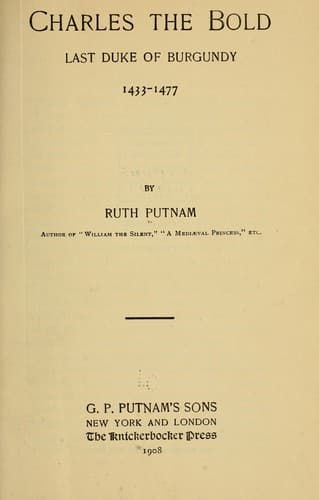
Charles the Bold, Last Duke of Burgundy, 1433-1477Putnam, Ruth
History
Charles the Bold, Last Duke of Burgundy, 1433-1477
Putnam, Ruth
Burgundy (France) -- History; Charles, Duke of Burgundy, 1433-1477; Switzerland -- History -- 1032-1499
At seven o'clock the victorious Duke of Lorraine rode into the rescued
city and re-entered his palace. At the gates was heaped up a ghastly
memorial of the steadfastness of the burghers in their devotion to
his cause. This was a pile of the bones of the foul animals they had
consumed when other food was exhausted, rather than capitulate to
their liege's foe. To ascertain the fate of that foe now became René's
chief anxiety, and he despatched messengers to Metz and elsewhere
to find out where Charles had taken refuge. The reports were all
negative. The first positive assurance that the duke was dead came
from young Baptista Colonna, whom Campobasso himself introduced into
René's presence on Monday evening. The page told his tale and declared
that he could point out the precise place where he had seen the Duke
of Burgundy fall. Accordingly, on Tuesday morning, January 7th, a
party went forth from Nancy to the desolate battlefield and were
guided by Colonna to the edge of a pool which he asserted confidently
was the very spot where he had seen Charles. Circumstantial evidence
went to give corroboration to his word, for the dozen or more bodies
that lay strewn along the ground in the immediate vicinity of the pool
were close friends and followers of the duke, men who would, in all
probability, have stayed faithfully by their master's person, a
volunteer bodyguard as long as they drew breath. These bodies were all
stripped naked. Harpies had already gathered what plunder they could
find, and no apparel or accoutrements were left to show the difference
in rank between noble and page. But the faces were recognisable and
they were identified as well-known nobles of the Burgundian court.
Separated from this group by a little space at the very edge of the
pool, was another naked body in still more doleful plight. The face
was disfigured beyond all semblance of what it might have been in
life. One cheek was bitten by wolves, one was imbedded in the frozen
slime. Yet there was evidence on the poor forsaken remains that
convinced the searchers that this was indeed the mortal part of the
great duke. Two wounds from a pick and a blow above the ear--inflicted
by "one named Humbert"--showed how death had been caused. The missing
teeth corresponded to those lost by Charles, there was a scar just
where he had received his wound at Montl'héry, the finger nails were
long like his, a wound on the shoulder, a fistula on the groin, and an
ingrowing nail were additional marks of identification,--six definite
proofs in all. Among those who gazed at this wretched sight, on that
January morning, were men intimately acquainted with the duke's
person.
Public-domain text, read in full here on John Shaqi.
Reviews
Reviews
No reviews yet
Be the first to share your thoughts on this work.
Elsewhere in the archive
Join the Discussion
Join the discussion
Sign in to leave a comment or review.
Sign InorCreate an account