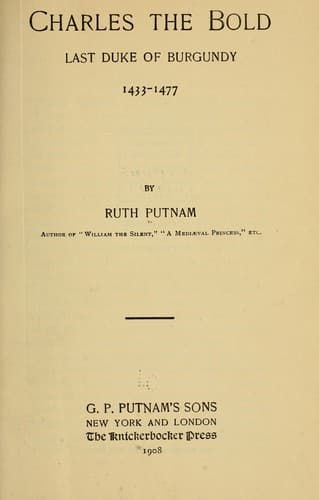
Charles the Bold, Last Duke of Burgundy, 1433-1477Putnam, Ruth
History
Charles the Bold, Last Duke of Burgundy, 1433-1477
Putnam, Ruth
Burgundy (France) -- History; Charles, Duke of Burgundy, 1433-1477; Switzerland -- History -- 1032-1499
In the twenty years that had elapsed since the Treaty of Arras, there
had been great changes in France in the character both of the realm
and of the ruler. Little by little the latter had proved himself to
be a very different person from the inert king of Bourges.[8] Old at
twenty, Charles VII. seemed young and vigorous at forty. Bad advisers
were replaced by others better chosen and his administration gradually
became effective. Fortune favoured him in depriving England of the
Duke of Bedford (1435), the one man who might have maintained English
prestige abroad and peace at home during the youth of Henry VI. It was
at a time of civil dissensions in England, that Charles VII. succeeded
in assuming the offensive on the Continent and in wresting Normandy
and Guienne from the late invader.
But this territorial advantage was not all. Distinct progress had been
made towards a national existence in France. The establishment of
the nucleus of a regular army was an immense aid in curbing the
depredations of the "_écorcheurs_," the devastating, marauding
bands which had harassed the provinces. There was new activity in
agriculture and industry and commerce.[9] The revival of letters and
art, never completely stifled, proved the real vitality of France in
spite of the depression of the Hundred Years' War. Royal justice was
reorganised, public finance was better administered. By 1456, misery
had not, indeed, disappeared, but it was less dominant.
The years of growing union between king and his kingdom were, however,
years of discord between Charles and his son. The dauphin Louis had
not enjoyed the pampered, petted life of his Burgundian cousin. Very
poor and forlorn was his father at the time of the birth of his heir
(1423).[10] There was nothing in the treasury to pay the chaplain who
baptised the child or the woman who nourished him. The latter received
no pension as was usual but a modest gratuity of fifteen pounds.
The first allowance settled on the heir to his unconsecrated royal
father's uncertain fortunes was ten crowns a month. Every feature of
his infancy was a marked contrast to the early life of the Count of
Charolais.
From his seventeenth year Louis was in active opposition to the
king, heading organised rebellion against him in the war called
the _Praguerie_. Finally, Charles VII. entrusted to his charge the
administration of Dauphiné, thus practically banishing him honourably
from the court where he was, evidently, a disturbing element. The only
restrictions placed upon him in his provincial government were such
as were necessary to preserve the ultimate authority of the crown. To
these restrictions, however, Louis paid not the slightest heed. He
assumed all the airs of an independent sovereign. He made wars and
treaties with his neighbours and at last proceeded to arrange his own
marriage.
Public-domain text, read in full here on John Shaqi.
Reviews
Reviews
No reviews yet
Be the first to share your thoughts on this work.
Join the Discussion
Join the discussion
Sign in to leave a comment or review.
Sign InorCreate an account