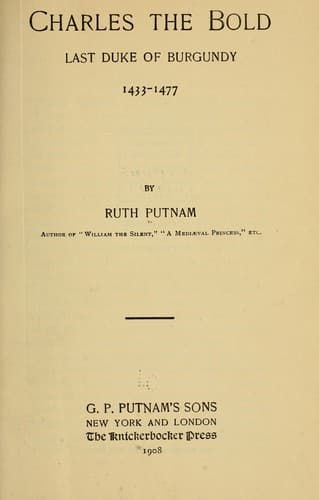
Charles the Bold, Last Duke of Burgundy, 1433-1477Putnam, Ruth
History
Charles the Bold, Last Duke of Burgundy, 1433-1477
Putnam, Ruth
Burgundy (France) -- History; Charles, Duke of Burgundy, 1433-1477; Switzerland -- History -- 1032-1499
Meantime, in the palace, consternation reigned. Search parties seeking
their sovereign were out all night. No one, however, was in such a
state of dismay as the dauphin, who declared that he would be counted
at fault when family dissensions followed so soon on his arrival.
Delighted he was, therefore, to act as mediator between father and
son after the duke was in a sufficiently pacified state to listen to
reason. Charles betook himself to Dendermonde for a time until the
duke was ready to see him[4]. His young wife made the most of her
expectations to soften her father-in-law's resentment, and between
her entreaties and those of the guest, proud to show his tact and his
gratitude, the quarrel was at last smoothed over.
There was one marked difference between this family dispute and the
breach between the French king and the dauphin. In the latter case no
feeling was involved. In the former, the son was really deeply wounded
by what he deemed lack of parental affection for his interests. At the
same time he was shocked by the bitter words and was, for the moment,
so filled with contrition that he was eager to make any concession
agreeable to the duke. He dismissed two of his servants[5], suspected
by his father of fomenting trouble between them, and he showed himself
in general very willing to placate paternal displeasure.
Reconciliation between duke and duchess was more difficult. Isabella
resented Philip's reproaches for her sympathy with Charles. She said
she had stepped between the two men because she had feared lest the
duke might injure his son in his wrath[6]. This was in answer to the
Marshal of Burgundy when he was telling her of Philip's displeasure.
She concluded her dignified defence with an expression of her utter
loneliness. Stranger in a strange land she had no one belonging to her
but her son.
She was certainly present at the baptism of her grandchild, but
shortly afterwards she retired to a convent of the Grey Sisters,
founded by herself, and rarely returned to the world or took part in
its ceremonies during the remainder of her life.
The quarrel, too, left its scar upon Charles. It is not probable that
he had much personal liking for the guest upon whom his father heaped
courtesies and solicitous care. On one occasion, when the two young
men were hunting they were separated by chance. When Charles returned
alone to the palace, the duke was full of reproaches at his son's
careless desertion of the guest in his charge. Again the court was
organised into search parties and there was no rest until the dauphin
was discovered some leagues from Brussels[7]. Here, also, it is an
easy presumption that the Count of Charolais was a trifle sulky over
his father's preoccupation in regard to the prince.
Public-domain text, read in full here on John Shaqi.
Reviews
Reviews
No reviews yet
Be the first to share your thoughts on this work.
Elsewhere in the archive
Join the Discussion
Join the discussion
Sign in to leave a comment or review.
Sign InorCreate an account