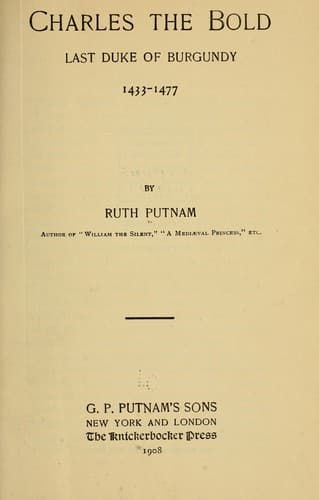
Charles the Bold, Last Duke of Burgundy, 1433-1477Putnam, Ruth
History
Charles the Bold, Last Duke of Burgundy, 1433-1477
Putnam, Ruth
Burgundy (France) -- History; Charles, Duke of Burgundy, 1433-1477; Switzerland -- History -- 1032-1499
The transient character of the dauphin's sojourn in his cousin's
domains soon changed. In the summer of 1457, when news came that
Dauphiné had submitted to Charles VII., when the successive embassies
despatched by Philip to the king had all proved fruitless in their
conciliatory efforts, Philip proceeded to make more permanent
arrangements for the fugitive's comfort.
"Now, Monseigneur, since the king has been pleased to deprive you
of Dauphiné ... you are to-day lord and prince without land. But,
nevertheless, you shall not be without a country, for all that I
have is yours and I place it within your hand without reserving
aught except my life and that of my wife. Pray take heart. If God
does not abandon me I will never abandon you[8]."
The duke made good his words by giving his guest the estate of
Genappe, of which Louis took possession at the end of July. Then as a
further step to make things pleasant for the exile, Philip sent for
Charlotte of Savoy who had remained under her father's care ever since
the formal marriage in 1451. She was now eighteen.
It was an agreeable spot, this estate at Genappe. Louis's favourite
amusement of the chase was easy of access. "The court is at present
at Louvain," wrote a courtier[9] on July 1st, "and Monseigneur the
Dauphin likes it very much, for there is good hunting and falconry and
a great number of rabbits within and without the city." With killing
of every kind at his service, what greater solace could a homeless
prince expect?
From Louvain to Genappe is no great distance, and the sum of 1200
livres, furnished by Philip for the dauphin's journey to his new
abode, seemed a large provision. The pension then settled on him was
36,000 livres, and when the dauphiness arrived 1000 livres a month
were provided for her private purse[10].
Pleasant was existence in this château. There was no dearth of company
to throng around the prince in exile, and the dauphin allowed no
prejudice of mere likes and dislikes, no consideration of duty towards
his host to hamper him in making useful friends. A word here and
a word there, aptly thrown in at a time when Philip's anger had
exasperated, when Charles had failed to conciliate, were very potent
in intimating to many a Burgundian servant that there might come a
time when a new king across the border might better appreciate their
real value than their present or future sovereign.
Hunting was a favourite amusement, but the dauphin did not confine his
invitations to sportsmen. The easy accessibility of the little court
attracted men of science and of letters as well as others capable of
making the time pass agreeably. When there was nothing else on foot,
it is said that the company amused themselves by telling stories,
each in turn, and out of their tales grew the collection of the _Cent
Nouvelles Nouvelles_[11], named in imitation of Boccaccio's _Cento
Novelle_.
Public-domain text, read in full here on John Shaqi.
Reviews
Reviews
No reviews yet
Be the first to share your thoughts on this work.
Elsewhere in the archive
Join the Discussion
Join the discussion
Sign in to leave a comment or review.
Sign InorCreate an account