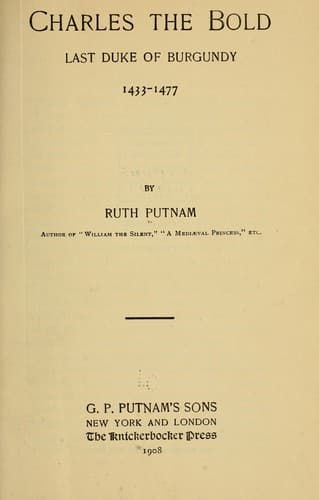
Charles the Bold, Last Duke of Burgundy, 1433-1477Putnam, Ruth
History
Charles the Bold, Last Duke of Burgundy, 1433-1477
Putnam, Ruth
Burgundy (France) -- History; Charles, Duke of Burgundy, 1433-1477; Switzerland -- History -- 1032-1499
Once within the walls, the duke found the whole community, who had
shown intelligent and sturdy determination not to endure arbitrary
tyranny, ready to weave themselves into a frenzy of biblical and
classical parable whose one purpose was to prove how evil had been
their ways. A pompous procession sang _Te Deum_ as the duke rode in,
and the first "mystery" that met his eyes within the gates was a
wonderful representation of Abraham sacrificing Isaac, while the
legend "All that the Lord commanded we will do," was meant not to
refer to the Hebrew's fidelity to Jehovah, but to the Ghenters'
perfect submission to Philip. A young girl stood ready to greet him
with the words of Solomon, "I have found one my soul loves."[14]
All the legends were in Latin. _Inveni quem diligit anima mea._]
Farther on there were various emblems all designed to compare
Philip now to Cæsar, now to Pompey, now to Nebuchadnezzar. The most
humiliating spectacle was that of a man dressed in a lion's skin,
thus personifying the Lion of Flanders, leading Philip's horse by the
bridle. "_Vive Bourgogne_ is now our cry," was symbolised in every
vehicle which the rhetoricians could invent.
Not altogether explicable is this extreme self-abnegation. Civic
prosperity must have returned in four years or there would have been
no money for the outlay. Apparently, Philip's countenance was worth
more to them than their pride.
The birth and death of two children at Genappe gave the duke new
reasons for showering ostentatious favours on his guest, and furnished
the dauphin with suitable occasion for addressing his own father, who
answered him in kind.
The following is one of the fair-phrased epistles[l5]:
_The King to the Dauphin_, 1459.
"VERY DEAR AND MUCH LOVED SON:
"We have received the letters that you wrote us making mention
that on July 27 our dear and much loved daughter, the dauphiness,
was delivered of a fine boy, for which we have been and are very
joyous, and it seems to me that the more God our Creator grants
you favour, by so much the more you ought to praise and thank
Him and refrain from angering Him, and in all things fulfil His
commandments.
"Given at Compiègne, Aug.7th.
"CHARLES.
During these five years, Charles was more or less aloof from the
courts of his father and of their guest. He spent part of the time in
Holland and part at Le Quesnoy with his young wife. The Count of St.
Pol was one of his intimate friends, and a friend who managed to
make many insinuations about the duke's treatment of his son and
infatuation about the Croys whom Charles hated with increasing
fervency.
There is a story that Charles went from Le Quesnoy to his father's
court to demand a formal audience from the duke in order to lodge his
protest against the Croys. Evidently relations were strained when such
a degree of ceremony was needed between father and son.
Public-domain text, read in full here on John Shaqi.
Reviews
Reviews
No reviews yet
Be the first to share your thoughts on this work.
Elsewhere in the archive
Join the Discussion
Join the discussion
Sign in to leave a comment or review.
Sign InorCreate an account