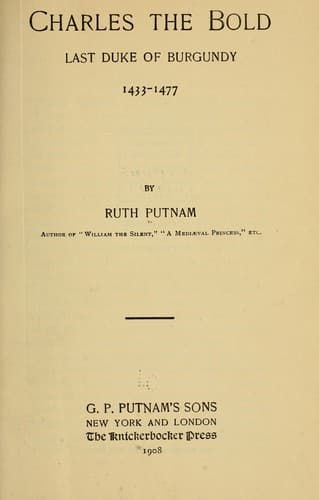
Charles the Bold, Last Duke of Burgundy, 1433-1477Putnam, Ruth
History
Charles the Bold, Last Duke of Burgundy, 1433-1477
Putnam, Ruth
Burgundy (France) -- History; Charles, Duke of Burgundy, 1433-1477; Switzerland -- History -- 1032-1499
The first printed edition of this collection was issued in Paris, in
1486, by Antoine Verard, who thus admonishes the gentle reader: "Note
that whenever _Monseigneur_ is referred to, Monseigneur the Dauphin
must be understood, who has since succeeded to the crown and is King
Louis. Then he was in the land of the Duke of Burgundy." Another
editor asserts that _Monseigneur_ is evidently the Duke of Burgundy
and not Louis, and later authorities decide that Anthony de la Sale
wrote the whole collection in imitation of Boccaccio, and that the
names of the narrators were as imaginative or rather as editorial as
the rest of the volume.
If this be true, it maybe inferred that the author would have given an
appearance of verisimilitude to his fiction by mentioning the actual
habitués of the dauphin's court. The name of the Count of Charolais
does not appear at all. The duke tells three or more stories according
to the interpretation given to _Monseigneur_. With three exceptions
the tales are very coarse, nor does their wit atone for their
licentiousness. Possibly Charles held himself aloof from the kind of
talk they suggest. All reports make him rigid in standards of morality
not observed by his fellows. That he had little to do with the court
is certain, whatever his reason.
Louis did not confine himself to the estate assigned him. There were
various court visits to the Flemish towns where he was afforded
excellent opportunities for seeing the wealth of the burghers and
their status in the world of commerce.
Ghent was very anxious to have the duke bring his guest within her
gates and give her an opportunity of displaying her regret for the
past unpleasantness. "In his goodness," Philip at last yielded to
their entreaties to make them a visit himself, but he decided not to
take the prince or the count with him.[12] He was either afraid for
their safety or else he did not care to bring a future French king
into relation with citizens who might find it convenient to remember
his suzerainty in order to ignore the wishes of their sovereign
duke.[13]
Eastertide, 1458, was finally appointed for this state visit of
reconciliation. The duke took the precaution to send scouts ahead to
ascertain that the late rebels were sincere in their contrition, and
that there was no danger of anarchist agitations. The report was
brought back that all was calm and that joyful preparations were
making to show appreciation of Philip's kindness.
On April 22d, the duke slept at l'Écluse, and on the 23d he was gaily
escorted into the city by knights and gentlemen summoned from Holland,
Hainaut, and Flanders, "but neither clerks nor priests were in his
train." As a further assurance to him of their peaceful intention,
the citizens actually lifted the city gates off their hinges so as to
leave open exits.
Public-domain text, read in full here on John Shaqi.
Reviews
Reviews
No reviews yet
Be the first to share your thoughts on this work.
Elsewhere in the archive
Join the Discussion
Join the discussion
Sign in to leave a comment or review.
Sign InorCreate an account