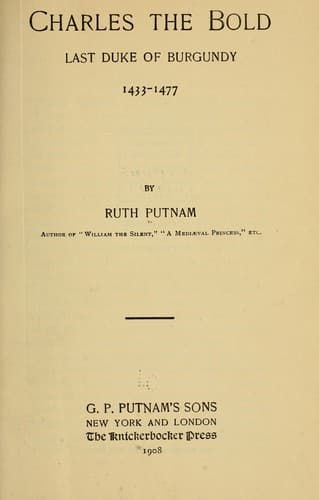
Charles the Bold, Last Duke of Burgundy, 1433-1477Putnam, Ruth
History
Charles the Bold, Last Duke of Burgundy, 1433-1477
Putnam, Ruth
Burgundy (France) -- History; Charles, Duke of Burgundy, 1433-1477; Switzerland -- History -- 1032-1499
For a long time before his final illness the death of Charles VII. was
anticipated. When it came it was a dolorous end.[18] At Genappe, the
dauphin had been making his preparations for the wished-for event in
many ways, all in exact opposition to his father's policy. In Italy
and in Spain he sided with the opponents of Charles VII. In England,
his sympathies were all for the House of York because his father was
favourable to Henry of Lancaster and Margaret of Anjou. He learned
with satisfaction of the success of Edward IV., and was more than
willing to see him invade France. With certain princes of Germany he
entertained relations shrouded in mystery, while his father's own
agents disclosed secrets to him from time to time.
In his exile he kept reminding official bodies at Paris that he was
heir to the throne. As dauphin he claimed the right to give orders to
the _parlement_ at Grenoble. There is no actual proof that he had a
hand in the conspiracies which troubled the last year of his father's
reign, but it is certain that he managed to win to himself a party
within the royal circle.
Certain councillors, fearful of their own fate, did not hesitate to
suggest that Louis should be disinherited and his brother Charles put
in his stead, but this Charles VII. would not accept. He kept hoping
for Louis's submission. The latter, however, had no idea of this. He
was sure that his father would not live to grow old. A trouble in his
leg threatened to be cancerous. In July, there was a growth in his
mouth. He died July 22nd, convinced that his son had poisoned him.
After July 17th constant bulletins from the king's bedside came to
Louis. Genappe was too far and the anxious son moved to Avesnes
in order to receive his messages more speedily. Our chronicler
Chastellain[19] begins his story of Louis's accession as follows:
"Since I am not English but French, I who am neither Spanish nor
Italian but French, I have written of two Frenchmen, the one king,
the other duke. I have written of their works and their quarrels
and of the favour and glories which God has given them in their
time.
* * * * *
"Kings die, reigns vanish but virtue alone and meritorious works
serve man on his bier and gain him eternal glory. O you Frenchmen,
see the cause and the end in my labours!"
The guest who had displayed so much humility and thankfulness when he
arrived, who had deprecated honours to his high birth and desired to
offer all the courtesies, departed from the residence so generously
given him for five years in a very cavalier manner.
Public-domain text, read in full here on John Shaqi.
Reviews
Reviews
No reviews yet
Be the first to share your thoughts on this work.
Elsewhere in the archive
Join the Discussion
Join the discussion
Sign in to leave a comment or review.
Sign InorCreate an account