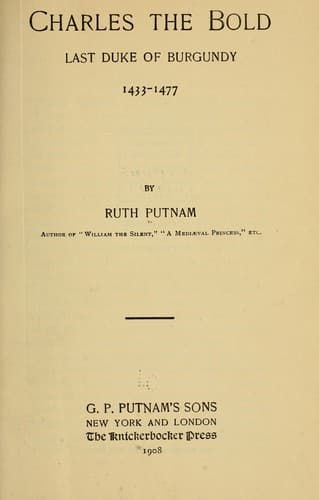
Charles the Bold, Last Duke of Burgundy, 1433-1477Putnam, Ruth
History
Charles the Bold, Last Duke of Burgundy, 1433-1477
Putnam, Ruth
Burgundy (France) -- History; Charles, Duke of Burgundy, 1433-1477; Switzerland -- History -- 1032-1499
He would set out at break of day with five or six intimates dressed in
grey cloth like pilgrims; archers and baggage followed at a distance.
He would forbid any one to follow him, and often ordered the gates of
the city he had left to be closed, or a bridge to be broken behind
him. Ambassadors ordered to see him without fail, sometimes had to
cross France to obtain an interview, at least if their object was
something in which he was not much interested. Then he would often
grant them an audience in some miserable little peasant hut.
In the cities where he stopped he would lodge with a burgomaster or
some functionary. To avoid harangues and receptions he would often
arrive unannounced through a little alley. If forced to accept an
_entrée_ he stipulated that it should not be marked with magnificence.
There never was a prince who so disliked ceremonies, balls, banquets,
and tourneys. At his court young people were bored to death. He never
ordered festivals except for some visitor; his pleasures were those
of a simple private gentleman. He liked to dine out of his palace.
Cagnola relates with surprise that he had seen the king dine after
mass in a tavern on the market-place at Tours. He invited small nobles
and bourgeois to dine with him. He was intimate, too, with bourgeois
women, and indulged in gross pleasantries, speaking to and of women
without reserve, sparing neither sister, mother, nor queen.
Yet it was a sombre court. "Farewell dames, citizens, demoiselles,
feasts, dances, jousts, and tournaments; farewell fair and gracious
maids, mundane pleasures, joys, and games," says Martial d'Auvergne.
Pompous magnificence may have reminded Louis unpleasantly of his visit
to Burgundy.
[Footnote 1: He had departed with Adolph de la Marck on November
19th.--_Archives du Nord_. See Du Fresne de Beaucourt, vi., 113. No
mention of this seems to appear elsewhere.]
[Footnote 2: Chastellain (iii., 233) says that he heard the story from
the clerk of the chapel, sole witness of this family quarrel. The duke
was so angry that it was hideous to see him.]
[Footnote 3: La Marche, ii., 418; Du Clercq, ii., 237; Chastellain,
iii., 230, etc. In the last the narrative is more elaborate. The
author dwells much on the danger to the young countess in her delicate
state of health.]
[Footnote 4: "Thus there was much coming and going: and it was ordered
by Monseigneur le Dauphin that Monseigneur de Ravestein and the
king-at-arms of the Toison d'Or should go to Dendermonde to learn the
wishes of the Count of Charolais and his intentions, of which I am
entitled to speak for I was despatched several times to Brussels in
behalf of my said Seigneur of Charolais, to ask the advice of the
Chancellor Raulin as to the best method of conducting the present
affair"--(La Marche, ii., 419.)]
[Footnote 5: La Marche, ii., 420. One of these, Guillaume Biche, went
to France and La Marche says that he himself often went to him to
obtain valuable information.]
Public-domain text, read in full here on John Shaqi.
Reviews
Reviews
No reviews yet
Be the first to share your thoughts on this work.
Elsewhere in the archive
Join the Discussion
Join the discussion
Sign in to leave a comment or review.
Sign InorCreate an account