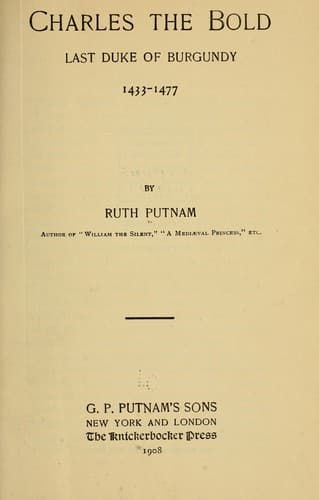
Charles the Bold, Last Duke of Burgundy, 1433-1477Putnam, Ruth
History
Charles the Bold, Last Duke of Burgundy, 1433-1477
Putnam, Ruth
Burgundy (France) -- History; Charles, Duke of Burgundy, 1433-1477; Switzerland -- History -- 1032-1499
Exasperated at the nonchalant manner in which Louis's ambassadors
treated him, indignant at the injury to his heritage by the redemption
of the towns on the Somme, and further, already alienated from his
royal cousin through the long series of petty occasions where the
different natures of the two young men clashed, in this year 1464,
Charles was certainly more than ready to enter into an open contest
with the French monarch. It was not long before the opportunity came
for him to do so with a certain éclat.
In the early years of his own freedom, before he learned wisdom, Louis
XI. had planted many seeds of enmity which brought forth a plentiful
crop, and the fruit was an open conspiracy among the nobles of the
land.
One of the causes of loosening feudal ties was the gradual growth of
the body of standing troops instituted in 1439 by Charles VII. These,
in the regular pay of the crown, gave the king a guarantee of support
without the aid of his nobles. By the date of Louis's accession,
certain ducal houses besides that of Burgundy had grown very
independent within their own boundaries: Orleans, Anjou, Bourbon, not
to speak of Brittany.[7] Now the efforts to curtail the prerogatives
of these petty sovereigns, begun by Charles VII., were steady and
persistent in the new reign. They had no longer the power of coining
money, of levying troops, or of imposing taxes, while the judicial
authority of the crown had been extended little by little over France.
Then their privileges were further attacked by Louis's restrictions of
the chase.
It was the accumulation of these invasions of local authority, added
to a real disbelief in the king's ability, that led to a formation of
a league among the nobles, designed to check the centralisation policy
of the monarch, a League of Public Weal to form a bulwark against the
tyrannical encroachments of their liege lord.
Not to follow the steps of the growth of this coalition, it is
sufficient for the thread of this narrative to say that it comprised
all the great French nobles, the princes of the blood as well as
others. Men whom Louis had flattered as well as those whom he had
slighted alike fell from his standards, distrustful of his ability to
withstand organised opposition, and they threw in their lot with the
protestors so as not to miss their share of the spoil.
Public-domain text, read in full here on John Shaqi.
Reviews
Reviews
No reviews yet
Be the first to share your thoughts on this work.
Elsewhere in the archive
Join the Discussion
Join the discussion
Sign in to leave a comment or review.
Sign InorCreate an account