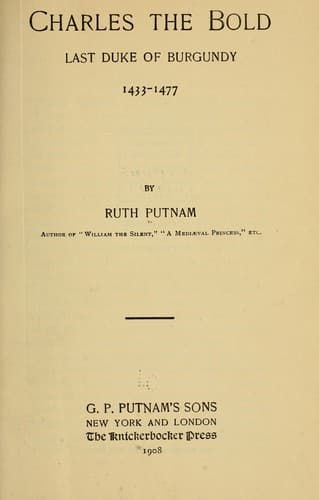
Charles the Bold, Last Duke of Burgundy, 1433-1477Putnam, Ruth
History
Charles the Bold, Last Duke of Burgundy, 1433-1477
Putnam, Ruth
Burgundy (France) -- History; Charles, Duke of Burgundy, 1433-1477; Switzerland -- History -- 1032-1499
Many skirmishes took place between the Parisians and the leaguers, but
no engagement. Once, indeed, there were hurried preparations on the
part of the Burgundians to repulse an attack, of whose imminence they
were warned by a page before break of day, one misty morning. Yes,
there was no doubt. The pickets could see the erect spears and furled
banners of the enemy all ready to advance upon the unwary camp. Quick
were the preparations. There were no laggards. The Duke of Calabria
was more quickly armed than even the Count of Charolais. He came to a
spot where a number of Burgundians, the count's own household stood,
by the standard. Among them was Commines[l2] and he heard the duke
say: "We now have our desire, for the king is issued forth with his
whole force and marches towards us as our scouts report. Wherefore let
us determine to play the men. So soon as they be out of the town we
will enter and measure with the long ell." By these words he meant
that the soldiers would speedily have a chance to use their pikes as
yard sticks to measure out their share of the booty. False prophet
was the duke that time! When the daylight grew stronger, the upright
spears and furled banners of the advancing foe proved to be a mass of
thistles looming large in the magnifying morning mist! The princes
took their disappointment philosophically, enjoyed early mass, and
then had their breakfast.
The young Commines is surprised that Paris and her environs were rich
enough to feed so many men. Gradually the aspect of affairs changed.
Negotiating back and forth became more frequent. The disintegration of
the allies became more and more evident. Louis XI. bided his time and
then took the extraordinary resolution to go in person to the camp at
Charenton to visit his cousin of Burgundy. With a very few attendants,
practically unguarded, he went down the Seine. His coming had been
heralded and the Count of Charolais stood ready to receive him, with
the Count of St. Pol at his side. "Brother, do you pledge me safety?"
(for the count's first wife was sister of Louis) to which the count
responded: "Yes, as one brother to another."[13]
Nothing could have been more genial than was the king. He assured
Charles that he loved a man who kept his word beyond anything.
Veracity was his passion. Charles had kept the promise he had sent by
the archbishop of Narbonne, and now he knew in very truth that he was
a gentleman and true to the blood of France. Further, he disavowed the
insolence of his chancellor towards Charles, and repeated that his
cousin had been justified in resenting it. "You have kept your promise
and that long before the day."[14]
Then in a friendly promenade, Louis gave an opportunity to Charles and
St. Pol to state, informally, the terms on which they would withdraw
from their hostile footing, and count the weal restored to the
oppressed public whose sorrows had moved them to a confederation.
Public-domain text, read in full here on John Shaqi.
Reviews
Reviews
No reviews yet
Be the first to share your thoughts on this work.
Elsewhere in the archive
Join the Discussion
Join the discussion
Sign in to leave a comment or review.
Sign InorCreate an account