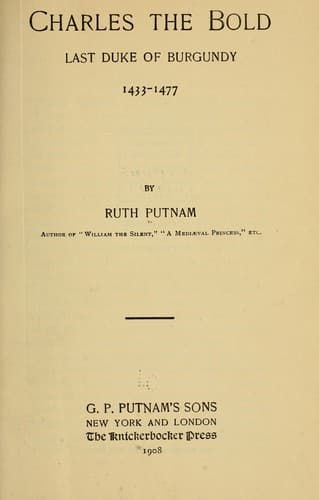
Charles the Bold, Last Duke of Burgundy, 1433-1477Putnam, Ruth
History
Charles the Bold, Last Duke of Burgundy, 1433-1477
Putnam, Ruth
Burgundy (France) -- History; Charles, Duke of Burgundy, 1433-1477; Switzerland -- History -- 1032-1499
In 1456, Philip of Burgundy, encouraged by his success in the diocese
of Utrecht, obtained a certain ascendency over the affairs of Liege by
interfering in the election of a bishop. There was no natural vacancy
at the moment. John of Heinsberg was the incumbent, a very pleasant
prelate with conciliatory ways. He loved amusement and gay society,
pleasures more easily obtainable in Philip's court than in his own,
and his agreeable host found means of persuading him to resign all the
cares of his see. Then the enterprising duke proceeded to place his
own nephew, Louis of Bourbon, upon the vacant episcopal throne.
This nephew was an eighteen-year-old student at the University of
Louvain, destitute of a single qualification for the office proposed.
Nevertheless, all difficulties, technical and general were ignored,
and a papal dispensation enabled the candidate even to dispense with
the formality of taking orders. Attired in scarlet with a feathered
Burgundian cap on his head, Louis made his entry into his future
capital and was duly enthroned as bishop-prince in spite of his
manifest unfitness for the place.
Nor did he prove a pleasant surprise to his people, better than the
promise of his youth, as some reckless princes have done. On the
contrary, ignorant, sensuous, extortionate, he was soon at drawn
swords with his subjects. After a time he withdrew to Huy where he
indulged in gross pleasures while he attempted to check the rebellious
citizens of his capital by trying some of the measures of coercion
used by his predecessors as a last resort.
Liege was lashed into a state of fury. Matters dragged on for a long
time. The people appealed to Cologne, to the papal legate, to the
pope, and to the "pope better informed," but no redress was given.
Philip continued to protect the bishop, and none dared put themselves
in opposition to him. Finally, the people turned to Louis XI. for aid.
Their appeal was heard and the king's agent arrived in the city
just as one of the bishop's interdicts was about to be enforced,
an interdict, too, endorsed by a papal bull, threatening the usual
anathema if the provisions were not obeyed.
It was the moment for a demagogue and one appeared in the person of
Raes de la Rivière, lord of Heers. On July 5, 1465, there was to be
unbroken silence in all sacred edifices. Heers and his followers
proclaimed that every priest who refused to chant should be thrown
into the river. Mass was said under those unpeaceful and unspiritual
conditions, and the presence of the French envoys gave new heart to
the bishop's opponents. A treaty was signed between the Liegeois
and Louis; wherein mutual pledges were made that no peace should be
concluded with Burgundy in which both parties were not included. It
was a solemn pledge but it did not hamper Louis when he signed the
treaty of Conflans whose articles contained not a single reference to
the Liegeois.
Public-domain text, read in full here on John Shaqi.
Reviews
Reviews
No reviews yet
Be the first to share your thoughts on this work.
Elsewhere in the archive
Join the Discussion
Join the discussion
Sign in to leave a comment or review.
Sign InorCreate an account