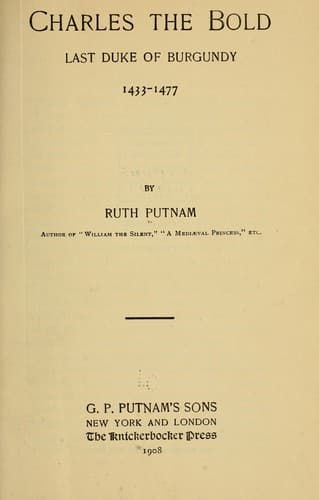
Charles the Bold, Last Duke of Burgundy, 1433-1477Putnam, Ruth
History
Charles the Bold, Last Duke of Burgundy, 1433-1477
Putnam, Ruth
Burgundy (France) -- History; Charles, Duke of Burgundy, 1433-1477; Switzerland -- History -- 1032-1499
Thus appeared Edward on the occasion of a tourney given in honour
of the embassy which La Marche proceeds to describe in detail. The
Bastard of Burgundy, wearing the Burgundian coat-of-arms with a bar
sinister, made a fine record for himself.
After the tournament he invited the ladies to a Sunday dinner,
"especially the Queen and her sisters and made great preparations
therefor and then we departed, Thomas de Loreille, Bailiff of
Caux, and I to go to Brittany to accomplish our embassy. We
arrived at Pleume and were obliged to await wind and boats to
go into Brittany. While there, came the news that the Duke of
Burgundy was dead. You may believe how great was the bastard's
mourning when he heard of his father's death, and how the nobility
who were with him mourned too. Their pleasures were melted into
tears and lamentations for he died like a prince in all valour.
"In his life he accomplished two things to the full. One was he
died as the richest prince of his time, for he left four hundred
thousand crowns of gold cash, seventy-two thousand marks of silver
plate, without counting rich tapestries, rings, gold dishes
garnished with precious stones, a large and well equipped library,
and rich furniture. For the second, he died as the most liberal
duke of his time. He married his nieces at his own expense; he
bore the whole cost of great wars several times. At his own
expense, he refitted the church and chapel at Jerusalem. He gave
ten thousand crowns to build the tower of Burgundy at Rhodes; ...
No one went from him who was not well recompensed. The state
he maintained was almost royal. For five years he supported
Monseigneur the Dauphin, and was a prince so renowned that all the
world spoke well of him."
The Bastard of Burgundy took leave of the English court and hastened
to Bruges to join his brother, the Count of Charolais, who received
him warmly. "Henceforth," explains Olivier, "when I mention the said
count I will call him the Duke of Burgundy as is reasonable."
Solemnly was the prince's body carried into the church of St. Donat
in Bruges, there to repose until it could be taken to Burgundy to be
buried at Dijon with his ancestors. La Marche dismisses the funeral
with a brief phrase as he was not himself present at Bruges, being
busied in Brittany. There was a memorial service there, the finest
he ever saw. The arms of Burgundy were inserted in the chapel
decorations, not merely pinned on,[2] a fact that impressed the
chronicler. No nobles, not even those from Flanders, were permitted to
put on mourning. The Duke of Brittany declared that none but him was
worthy of the honour for so high a prince.
Public-domain text, read in full here on John Shaqi.
Reviews
Reviews
No reviews yet
Be the first to share your thoughts on this work.
Elsewhere in the archive
Join the Discussion
Join the discussion
Sign in to leave a comment or review.
Sign InorCreate an account