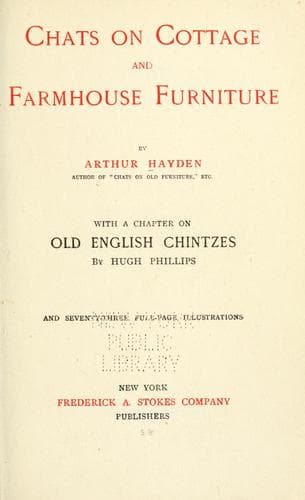
Chats on Cottage and Farmhouse FurnitureHayden, Arthur
History
Chats on Cottage and Farmhouse Furniture
Hayden, Arthur
Country furniture -- England; Furniture -- England; Textile fabrics -- England
In order to deal exhaustively with the evolution of the chair
from its earliest forms to the latest developments in sumptuous
upholstery, it would be necessary to make an extended survey of
furniture, dating back to early classic days. To enumerate the
manifold varieties belonging to various countries and to trace
the gradual progress in form, which kept pace with the advance in
civilisation, would be of sufficient interest to occupy a whole
volume. Man, as a sitting or lounging animal, has grown to require
more elaborate forms of chair, or settee, or sofa, and the modern
tendency has been towards comfort and luxury.
In regard to English furniture the intense contrast between the days
of Elizabeth and those of Victoria is at once noticeable. According
to Lord Macaulay in his comparison between the manners of his day and
those of the past, the furniture of a middle-class dwelling-house of
the nineteenth century was equal to that of a rich merchant in the
time of Elizabeth. In general this may be true, though not as regards
the spacious structure and the massive grandeur of the Tudor house.
In many details the differences are most noteworthy. The wide gulf
dividing the modern world from the days of the Armada may be realised
by reflecting on such an astounding fact that Queen Elizabeth
possessed at one time the only pair of silk stockings in her realm,
which were presented to her by Mistress Montague, "which pleased her
so well that she would never wear any cloth hose afterwards."
The sturdy character of the yeomen of the days of the Tudors is
exhibited in their furniture. The illustrations of this chapter in
regard to the chair and its structural development indicate the
slowly acquired tastes, running some decades behind the fashionable
furniture, strong with foreign influences, which had come into more
or less general use. "England no longer sent her fleeces to be woven
in Flanders and to be dyed in Florence. The spinning of yarn, the
weaving, fulling, and dyeing of cloth, was spreading rapidly from the
towns to the country-side. The worsted trade, of which Norwich was
the centre, extended over the whole of the Eastern Counties. Farmers'
wives everywhere began to spin their wool from their own sheep's
backs into a coarse homespun."
Public-domain text, read in full here on John Shaqi.
Reviews
Reviews
No reviews yet
Be the first to share your thoughts on this work.
Join the Discussion
Join the discussion
Sign in to leave a comment or review.
Sign InorCreate an account