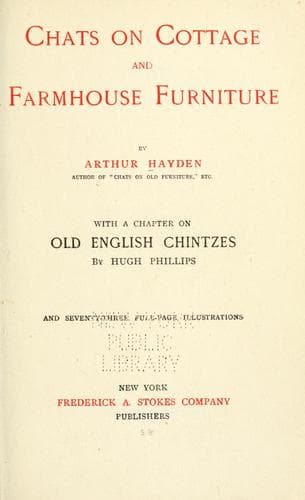
Chats on Cottage and Farmhouse FurnitureHayden, Arthur
History
Chats on Cottage and Farmhouse Furniture
Hayden, Arthur
Country furniture -- England; Furniture -- England; Textile fabrics -- England
The unassuming simplicity of this class of chair made its appeal
to Madox-Brown, who held that simplicity and utility were the two
desiderata, united with soundness of construction, for domestic
furniture. Veneer was as abhorrent to him as to all genuine lovers
of the artistic. "Let us be honest, let us be genuine in furniture
as in aught else," were his words. "If we must needs make our chairs
and tables of cheap wood, do not let them masquerade as mahogany or
rosewood; let the thing appear that which it is; it will not lack
dignity if it be good of its kind and well made." Accordingly he put
his theories into practice and designed some furniture. In a chair in
the possession of Mr. Harold Rathbone he has employed the rush seat
and used spindles to decorate the back, and in another chair in the
same collection he has adhered to the horizontal ladder-back style,
coupled with the rush seat, with pleasing effect.
=Corner Chairs.=--Among interesting types of chairs often with
lingering traces of the Jacobean style and additional features
of splats that may be regarded as standing on the threshold of
the Chippendale period, corner chairs stand in a class alone. The
illustrations on p. 237 show some typical examples. The chair with
the double tier is the oak adaptation of Chippendale with the
retention of the old Jacobean form of support for the arm. These
chairs with this added tier are often used as country barber's
chairs. The rush-seated corner chair on the same page, probably made
in Lancashire, is suggestive of the ladder-back form, and there
are indications in its construction that it is subsequent to the
Hepplewhite period.
With these notes relative to the evolution of the chair, and with
carefully selected illustrations of types likely to be of use to the
collector, enough has been said to whet the curiosity of the reader
to study the matter for himself. It requires keen and discriminating
judgment to allocate specimens with passing exactitude as to time and
place. The taste for the subject must be natural and not acquired.
Training alone will give the eye the readiness to detect false
touches and modern additions. The search for bargains goes on apace,
and those who enjoy stalking their quarry in out-of-the-way places
have an exciting quest nowadays for fine pieces. To those with
endless patience, forbearing under disappointment, and having plenty
of leisure, the search will offer abundant delight, if, to quote Mrs.
Battle, they enjoy "the rigour of the game."
CHAPTER VIII
THE WINDSOR CHAIR
CHAPTER VIII
THE WINDSOR CHAIR
Early types--The stick legs without stretcher--The tavern
chair--Eighteenth-century pleasure gardens--The rail-back
variety--Chippendale style Windsor chairs--The survival of the
Windsor chair.
Public-domain text, read in full here on John Shaqi.
Reviews
Reviews
No reviews yet
Be the first to share your thoughts on this work.
Elsewhere in the archive
Join the Discussion
Join the discussion
Sign in to leave a comment or review.
Sign InorCreate an account