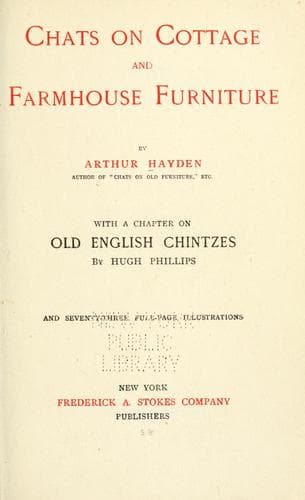
Chats on Cottage and Farmhouse FurnitureHayden, Arthur
History
Chats on Cottage and Farmhouse Furniture
Hayden, Arthur
Country furniture -- England; Furniture -- England; Textile fabrics -- England
The mode of casting these iron firebacks in sand and the employment
of wooden patterns to form the mould into which the molten metal was
to run is familiar to any foundry in casting iron. In regard to the
early examples with the twisted cable rim, it is conjectured that
pieces of twisted rope were actually laid on the wet sand to produce
this pattern--that is, before the use of carved wooden patterns
such as are illustrated. In regard to the bolder "cable twist"
pattern, it is believed this was produced by impression of pieces of
rope stiffened with glue, and twisted around iron rods.
[Illustration: SUSSEX IRON FIREBACK. FIRST HALF OF SIXTEENTH
CENTURY.
Rope-like border impressed on sand mould. The field impressed
with repetitions from a single _fleur-de-lys_ stamp.]
[Illustration: SUSSEX IRON FIREBACK.
The Royal Oak Design, commemorative of the Restoration. Late
Seventeenth Century. Moulded edge and carved in one piece from a
single pattern.
(_In the collection of Charles Dawson, Esq., F.S.A., Lewes._)]
[Illustration: SUSSEX FIREBACKS.
Tudor Rose surmounted by Royal
Crown. Dated 1650.
Depicting Ironmaster at his Forge.
(Very rusty and worn.)]
[Illustration: ORIGINAL WOODEN PATTERNS.
Dutch influence. Eighteenth Century. From which firebacks were
made at Ashburnham, Sussex.
(_By the courtesy of Charles Dawson, Esq., F.S.A., Lewes._)]
The size of the wooden pattern is slightly larger than the resultant
fireback, owing to the shrinkage of the metal on cooling. This
diminution in design is a factor in the potter's art, when figures
in some cases lose nearly a third of their original proportions when
moulded in the clay prior to firing.
Firebacks have attracted a considerable amount of interest. There are
many collectors, and a great deal of close study has been applied to
the subject. Country museums in the vicinity of the Weald of Sussex
and Kent contain many notable examples, especially those of Lewes,
Hastings, Brighton, Rochester, Maidstone, and Guildford. In the first
mentioned there are some very rare and beautiful examples of Sussex
firebacks.
Especially interesting in connection with the Sussex ironworks is the
illustration (p. 309) of a clock face made by a local maker, Beeching
of Ashburnham, in the late seventeenth century. This brass dial of a
thirty-hour clock, with single hand and alarum, is ornamented with
designs showing various phases of the iron industry as carried on in
Sussex. There is a cannon with diminutive figures holding the match.
There are cannon-balls, and a liliputian fireback with a crown on
it. Men with pickaxes, men felling trees, and others tending the
furnaces, symbolise the business of a foundry.
It was not until 1690 that the minute numerals were placed outside
the minute divisions in clock faces, so that this face, having the
minute numerals absent and the minute divisions in the inner circle,
presumably belongs to the late seventeenth century.
Public-domain text, read in full here on John Shaqi.
Reviews
Reviews
No reviews yet
Be the first to share your thoughts on this work.
Elsewhere in the archive
Join the Discussion
Join the discussion
Sign in to leave a comment or review.
Sign InorCreate an account