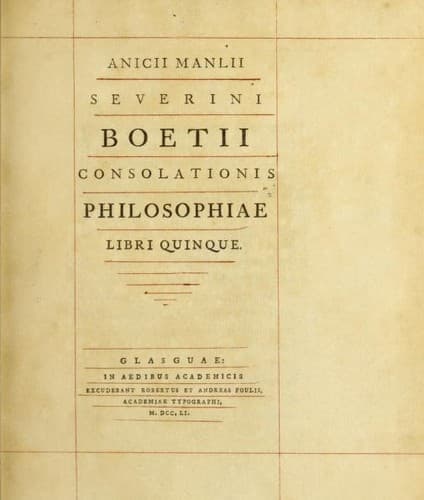
Chaucer's Translation of Boethius's "De Consolatione Philosophiae"Boethius
ReligionComparative
Chaucer's Translation of Boethius's "De Consolatione Philosophiae"
Boethius
Happiness; Philosophy and religion
¶ Certys q{uo}d I it remembreþ me nat þat euere I was
so free of my þouȝt. þat I ne was al-wey in anguysh{e} of 1912
somwhat.
[Sidenote: _P._ That was because something was absent which you
did desire, or something present which you would fain be quit of.]
þ{a}t was þat þou lakkedest þat þou noldest
han lakked. or ellys þou haddest þat þou noldest
han had.
[Sidenote: _B._ That’s quite true.]
ryȝt so is it q{uod} I þan.
[Sidenote: _P._ Then you did desire the presence of the one and
the absence of the other?]
desiredest þou
þe p{re}sence of þat oon {and} þe absence of þat oþer. 1916
[Sidenote: _B._ I confess I did.]
I graunt[e] wel q{uod} .I.
[Sidenote: _P._ Every man is in need of what he desires.]
for soþe q{uod} she þan nediþ þer
somwhat þat euery man desireþ.
[Sidenote: _B._ Certainly he is.]
ȝe þer nediþ q{uod} I.
[Sidenote: _P._ If a man lack anything can he be supremely happy?]
¶ Certis q{uod} she {and} he þat haþ lakke or nede of a
wyȝt nis nat in euery way suffisaunt to hym self. 1920
[Sidenote: _B._ No.]
no q{uod} .I.
[Sidenote: _P._ Did you not in your abundance want for somewhat?]
{and} þou q{uo}d she in alle þe plente of þi
rycchesse haddest þilke lak of suffisaunce.
[Sidenote: _B._ What then if I did?]
¶ what
ellis q{uod} .I.
[Sidenote: _P._ It follows that riches cannot put a man beyond all
want, although this was what they seemed to promise.]
¶ þanne may nat rycchesse maken þat a
man nis nedy. ne þat he be suffisaunt to hym self. {and} 1924
þat was it þ{a}t þei byhyȝten as it semeþ.
[Sidenote: Money may part company with its owner, however
unwilling he may be to lose it.]
¶ and eke
certys I trowe þat þis be gretly to consydere þat moneye
ne haþ nat in hys owen kynde þat it ne may ben by-nomen
of hem þat han it maugre hem.
[Sidenote: _B._ I confess that’s true.]
¶ I by-knowe 1928
it wel q{uod} I
[Sidenote: _P._ It ought to be confessed when every day we see
_might_ prevailing over _right_.]
¶ whi sholdest þou nat by-knowen it
q{uod} she. whan euery day þe strenger folke by-nymen
it fram þe febler maugre hem.
[Sidenote: From whence springs so much litigation, but from this,
that men seek to recover their own of which they have been
unjustly deprived?]
¶ Fro whennes comen
ellys alle þise foreine compleintes or quereles of 1932
plety{n}g{us}. ¶ But for þat men axen aȝeine her moneye
þat haþ be by-nomen hem by force or by gyle. {and}
alwey maugre hem.
[Sidenote: _B._ Nothing is more true.]
¶ Ryȝt so it is q{uod} I.
[Sidenote: _P._ Then a man needs the assistance of others in order
to keep his riches.]
Public-domain text, read in full here on John Shaqi.
Reviews
Reviews
No reviews yet
Be the first to share your thoughts on this work.
Elsewhere in the archive
Join the Discussion
Join the discussion
Sign in to leave a comment or review.
Sign InorCreate an account