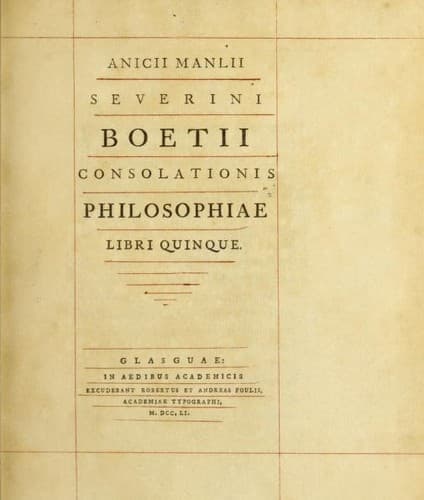
Chaucer's Translation of Boethius's "De Consolatione Philosophiae"Boethius
ReligionComparative
Chaucer's Translation of Boethius's "De Consolatione Philosophiae"
Boethius
Happiness; Philosophy and religion
++Þerfore yif þat fortune spake wiþ þe for hir self in þis manere. For
soþe þou ne haddest [nat] what þou myȝtest answere. and if þou hast any
þi{n}g wherwiþ. þou mayist ryȝtfully tellen þi co{m}pleynt. ¶ It byhoueþ
þe to shewen it. {and} .I. wol ȝeue þe space to tellen it. ¶ Certeynely
q{uod} I þan þise ben faire þinges {and} enoyntid wiþ hony swetnesse of
rethorike {and} musike. {and} only while þei ben herd þei ben
deliciouse. ¶ But to wrecches is a deppere felyng of harme. þis is to
seyn þat wrecches felen þe harmes þat þei suffren more greuously þan þe
remedies or þe delites of þise wordes mowe gladen or comforten hem. so
þat whan þise þinges stynten forto sou{n}[e] in eres. þe sorwe þat is
inset greueþ þe þouȝt. Ryȝt so is it q{uod} she. ¶ For þise ne ben ȝit
none remedies of þi maladie. but þei ben a manere norissinges of þi
sorwe ȝit rebel aȝeyne þi curac{i}ou{n}. ¶ For whan þat tyme is. I shal
moue swiche þinges þat p{er}cen hem self depe. ¶ But naþeles þ{a}t þou
shalt not wilne to leten þi self a wrecche. ¶ Hast þou forȝeten þe
nou{m}bre {and} þe manere of þi welefulnesse. I holde me stille how þat
þe souerayn men of þe Citee toke{n} þe in cure {and} kepynge whan þou
were orphelyn of fadir {and} modir. {and} were chosen i{n} affinite of
p{r}inces of þe Citee. ¶ And þou bygu{n}ne raþer to ben leef {and} deere
þan0 forto ben a neyȝbo{ur}. þe whiche þing is þe most p{re}ciouse kynde
of any p{ro}pinquitee or aliau{n}ce þat may ben. ¶ Who is it þat ne
seide þou nere ryȝt weleful wiþ so grete a nobley of þi fadres in lawe.
¶ {And} wiþ þe chastite of þi wijf. {and} wiþ þe oportunite {and}
noblesse of þi masculyn children. þat is to seyne þi sones {and} ou{er}
al þis me lyst to passe of comune þinges. ¶ How þou haddest in þi þouȝt
dignitees þat weren warned to olde men. but it deliteþ me to comen now
to þe singuler vphepyng of þi welefulnesse. ¶ Yif any fruyt of mortal
þinges may han any weyȝte or price of welefulnesse. ¶ Myȝtest þou euere
forȝeten for any charge of harme þat myȝt[e] byfallen. þe remembrau{n}ce
of þilke day þat þou sey[e] þi two sones maked conseillers. {and} ylad
to gidre from þin house vndir so gret assemble of senatours. {and} vndir
þe blyþenesse of poeple. {and} whan þou say[e] hem sette in þe court in
her chaieres of dignites. ¶ Þou rethorien or p{ro}nou{n}cere of kynges
p{re}ysinges. deseruedest glorie of wit {and} of eloquence. whan þou
sittyng bytwix þi two sones conseillers in þe place þat hyȝt Circo.
{and} fulfildest þe abydyng of multitude of poeple þat was sprad about
þe wiþ large p{ra}ysynge {and} laude as me{n} syngen in victories. þo
ȝaue þou wordes of fortune as I trowe. þat is to seyne. þo feffedest þou
fortune wiþ glosynge wordes {and} desseiuedest hir. whan she accoied[e]
þe {and} norsshed[e] þe as hir owen delices. ¶ Þou hast had of fortune a
ȝifte þat is to seyn swiche gerdou{n} þat she neu[er]e ȝaf to p{re}ue
man ¶ Wilt þou þerfore leye a rekenyng wiþ fortune. she haþ now
Public-domain text, read in full here on John Shaqi.
Reviews
Reviews
No reviews yet
Be the first to share your thoughts on this work.
Elsewhere in the archive
Join the Discussion
Join the discussion
Sign in to leave a comment or review.
Sign InorCreate an account