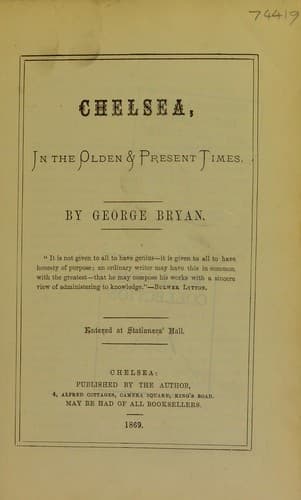
Chelsea, in the Olden & Present TimesBryan, George
History
Chelsea, in the Olden & Present Times
Bryan, George
Chelsea (London, England) -- History
In bloom of youth, midst sweet companions dwelling,
With elegant and tuneful arts excelling,
Fate did Sempronia suddenly remove:
Submissive to the wise behests of Heaven,
Those lov’d companions (full of hope) have given
To her this token of their loss and love.
W. B.
Near the preceding was a plaster cast of Dr. Burney, author of the
History of Music, taken from the original bust by Nollekens. The three
drawing-rooms were of the same dimensions as the hall; the first was
ornamented with several mosaic and fresco paintings from Herculaneum, and
other works of ancient arts. In the next apartments were portraits of
Bishop North, and his lady. Along the gallery which led to the garden
were disposed, in glass cases, a rich variety of beautiful shells, with
spars and ores, and a large collection of Italian marbles. The house was
also adorned with many specimens of modern art, in modelling and
painting, executed by Miss North, the Hon. Mr. Brownlow North, and by
others of his lordship’s family.
* * * * *
Winchester House was well and expensively supplied with water, conveyed
by pipes from a conduit, built by Henry VIII., situated in the King’s
forcing grounds at Kensington.
* * * * *
Upon pulling down the palace a singular discovery was made. In a small
room, to the north front, and at the north-west corner, were found on the
plaster of the walls, nine figures of the size of life, viz., three men
and six women, drawn in outline with black chalk in a bold and animated
style. Various opinions have been given respecting these spirited
sketches. They displayed much of the _manner_ of Hogarth, who lived on
intimate terms with Bishop Hoadly, and it was supposed that these figures
applied to some domestic incident in the bishop’s family, or to some
scene in a play. His lordship’s partiality for the drama was great. A
near relative, who resided in Chelsea, wrote the comedy of “The
Suspicious Husband.”
* * * * *
The palace remained unoccupied after the death of Bishop North; for Lady
Tomline, the wife of Bishop Tomline, conceived a dislike to the place
altogether. His lordship, in consequence, applied to Parliament and
obtained an Act to enable him to sell the premises. The Lord of the
Manor became the purchaser; and subsequently the whole fabric was sold by
auction.
Description of the Manor House.
As full particulars have already been given of the distinguished
occupiers of the ancient Manor House, Cheyne Walk, it is here only
necessary to describe the structure of this once celebrated residence.
{105}
* * * * *
Public-domain text, read in full here on John Shaqi.
Reviews
Reviews
No reviews yet
Be the first to share your thoughts on this work.
Elsewhere in the archive
Join the Discussion
Join the discussion
Sign in to leave a comment or review.
Sign InorCreate an account