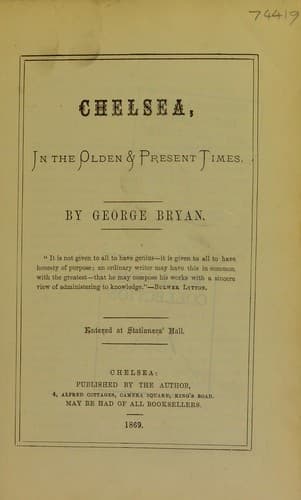
Chelsea, in the Olden & Present TimesBryan, George
History
Chelsea, in the Olden & Present Times
Bryan, George
Chelsea (London, England) -- History
We will now notice one of the most distinguished scholars and clergymen
of the early part of the present century, the Rev. Weeden Butler, who
resided in the above-mentioned house for a great many years, and also one
of his sons, etc., until a comparatively recent period, and which cannot
fail to be highly interesting to a large number of readers.
* * * * *
The Rev. Weeden Butler was born at Margate, in 1742. When aged fourteen,
he lost both his parents; and with his own free will was articled as
clerk to Mr. Rosewell, a respectable solicitor, in Angel Court,
Throgmorton Street, London. At the expiration of his term, he was
offered by his considerate late master and constant friend till death, a
share in the business; but he had determined to renounce for ever the
profession of the law, and resolved, by intense study and application, to
improve his superior intellectual powers, and ardently to prepare himself
for holy orders. About this time, he frequented all the churches and
chapels within and around the vast metropolis, as an enquirer after
truth. The result of his search fixed his choice, and he devoted his
time thenceforth, as a firm member of the Establishment, upon the fullest
conviction of its excellence. The course of his classical and
theological reading was directed by that splendidly and variously gifted,
but most unhappy character, Dr. William Dodd, to whom, for a salary of
small extent, he acted as an assiduous amanuensis, till his patron’s
ignominious death, in 1777.
* * * * *
Dr. Dodd’s “Commentary on the Holy Bible,” was partly compiled, and
wholly written out for the press, by the then unknown Rev. Weeden Butler,
who also greatly assisted in editing the four last volumes of “The
Christian’s Magazine,” and corrected the proof sheets of the poem, in
blank vase, “Thoughts in Prison,” of which Dr. Dodd’s own MS. was in the
possession of Mr. Butler’s eldest son in 1829–30. In this last
singularly affecting composition occur lines indicative of the worth of
the person eulogized, and of the author’s gratitude:—
“But I am lost! a criminal adjudg’d!
A guilty miscreant! can’st thou think, my friend!
Oh! BUTLER ’midst a million faithful found;
Oh! can’st thou think, who know’st, who long hast known,
My inmost soul; oh! can’st thou think, that life,” &c.
Public-domain text, read in full here on John Shaqi.
Reviews
Reviews
No reviews yet
Be the first to share your thoughts on this work.
Elsewhere in the archive
Join the Discussion
Join the discussion
Sign in to leave a comment or review.
Sign InorCreate an account