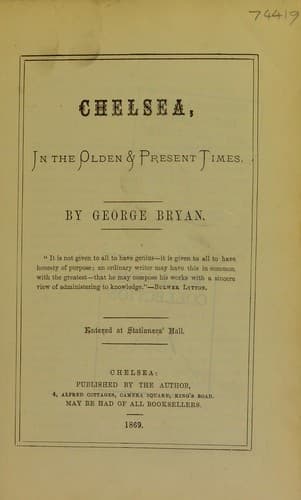
Chelsea, in the Olden & Present TimesBryan, George
History
Chelsea, in the Olden & Present Times
Bryan, George
Chelsea (London, England) -- History
He is highly spoken of in the Spectator. He wrote one play, called “The
Country Wake,” a comedy, acted with great applause; and out of this play
were made two farces, “Hob, or the Country Wake,” and “Hob’s Wedding.”
The first has been acted often with great success, and likewise several
songs have been added to it in imitation of the Beggar’s Opera, since
which it has been acted under the title of Flora.
* * * * *
In his political principles he was, in the words of Sir Richard Steele,
“a Whig up to head and ears;” and he took every occasion of demonstrating
his loyalty to the house of Hanover. One instance, among others, is well
known; which is, that in the year after King George I. came to the
throne, in 1715, Doggett gave a waterman’s orange-coloured coat and
silver badge to be rowed for; on the latter is represented the Hanoverian
horse.
* * * * *
This contest takes place on the 1st day of August, being the anniversary
of that King’s accession to the throne, between six young watermen, who
had just completed their apprenticeship; the claimants starting off on a
signal being given at that time of the tide when the current is strongest
against them, and rowing from the Old Swan, near London Bridge, to the
White Swan, at Chelsea. This tavern adjoined the Apothecaries’ Botanical
Garden, on the east, and enjoyed a great share of public favour for many
years; but in the year 1780, it was converted into a Brewhouse. Since
this period, the place of landing the victor has been at a house bearing
the same sign, near to Cheyne Walk. I have been favoured with the
following chorus, said to be written by a waterman:—
“Let your oars, like lightning flog it,
Up the Thames as swiftly jog it,
An’ you’d win the prize of Doggett,
The glory of the river!
Bendin’, bowin’, strainin’, rowin’,
Perhaps the wind in fury blowin’,
Or the tide agin you flowin’,
The coat and badge for ever!”
Mr. Doggett, at his death, left a sum of money, the interest of which was
to pay for the same for ever.
* * * * *
The “Yorkshire Grey” public house stood at the west corner of Old Manor
Street, opposite the river. It was a very old tavern, mostly frequented
of late years by the watermen who plied at the stairs opposite to it. It
has recently been pulled down, and two good private dwelling houses now
occupy the site.
* * * * *
In the year 1824, a new road was opened, connecting Old and New Manor
Street, forming a direct communication from Cheyne Walk to the King’s
Road, and St. Luke’s Church. Prior to that period a large garden crossed
the street, with a wall and iron railing, so that the two streets were
entirely detached.
* * * * *
Public-domain text, read in full here on John Shaqi.
Reviews
Reviews
No reviews yet
Be the first to share your thoughts on this work.
Elsewhere in the archive
Join the Discussion
Join the discussion
Sign in to leave a comment or review.
Sign InorCreate an account