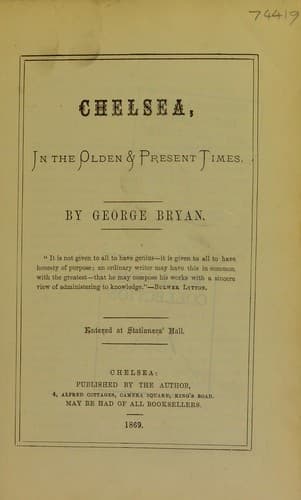
Chelsea, in the Olden & Present TimesBryan, George
History
Chelsea, in the Olden & Present Times
Bryan, George
Chelsea (London, England) -- History
A circumstance occurred in reference to these massive and splendid
central chandeliers, at nearly the conclusion of one of the Sunday
Evening Services, which occasioned great excitement amongst the
congregation, and it was feared at the time would be attended with loss
of life, but fortunately only one elderly person was seriously injured.
These chandeliers were obliged to be lowered by means of a windlass, and
men from the contractor for lighting the church, by oil-lamps, had to
attend and lower them both before and after Divine Service, in the first
instance for the purpose of lighting, and secondly to extinguish the
lights. It was the practice of these men, who came from London, and were
anxious to return home as soon as possible, to lower the weighty
chandeliers on a certain signal being given to them at the belfry door,
as soon as the organist commenced “playing the congregation out,” but on
this occasion it was a sermon in aid of a charity, and the organ was only
played previous to the singing of a hymn while the collection was being
made. This caused the mistake. Some of the congregation in the
galleries, perceiving that one of the chandeliers was unsteady and slowly
descending, rushed forward to make their exit, which created great
confusion and alarm, the result being the accident previously mentioned.
The Hon. and Rev. Dr. Wellesley, rector, being present, although not
officiating, immediately explained the circumstances, and soon afterwards
the alarm was allayed and the service concluded. The lighting of these
oil-lamps was attended with great expense and much labour. A
considerable saving is now effected by the introduction of gas, labour on
the Sunday is lessened, and the dirt occasioned by the trimming of the
lamps altogether obviated.
* * * * *
The galleries, south and north, are well constructed. There is breadth
of surface and simplicity of outline throughout. From some positions the
columns of the nave, which impart such a grandeur to the entire interior,
impedes the view of the preacher, even from the northern gallery, but
this is unavoidable in Gothic architecture.
* * * * *
At the eastern end, the great window, 32 ft. high, and 16 ft. wide, is a
most conspicuous feature. The bottom of the window, being 22 ft. from
the pavement, affords ample space for the altar-piece, which is designed
in the manner of a Gothic shrine or screen.
* * * * *
The altar, or communion, is ascended by three steps, and is enclosed by a
Gothic railing. The chairs and stools are designed in character, and are
good specimens of wood carving; they were executed by Mr. Relph, from the
designs of the architect.
* * * * *
The altar-piece is “The Entombing of Christ,” by Northcote. It had been
previously exhibited at the British Institution, Pall Mall.
* * * * *
Public-domain text, read in full here on John Shaqi.
Reviews
Reviews
No reviews yet
Be the first to share your thoughts on this work.
Elsewhere in the archive
Join the Discussion
Join the discussion
Sign in to leave a comment or review.
Sign InorCreate an account