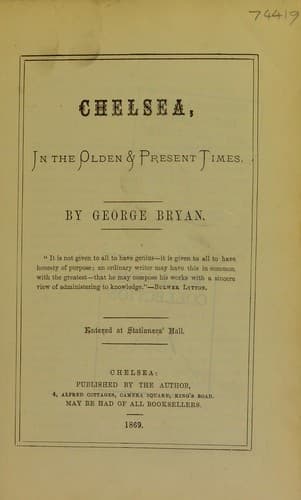
Chelsea, in the Olden & Present TimesBryan, George
History
Chelsea, in the Olden & Present Times
Bryan, George
Chelsea (London, England) -- History
And there have aged pilgrims stood,
(Now safely pass’d o’er Jordan’s flood,
And gain’d blest Canaan’s shore,)
Each burthen there they seem’d to cast,
As if each danger they had pass’d,
And all their toil was o’er.
And last I’ve seen the funeral train,
Like mourners on a desert plain,
Come slowly with their load:—
I’ve stood beside the silent bier,
And watch’d the trickling kindred tear
Fall in death’s drear abode.
Oh! when I view that sacred tower,
At morning or at evening hour,
By pure devotion led,
I love to meditate awhile—
I think I see some angels smile
Above the peaceful dead!
_Chelsea_, 1867.
GEORGE BRYAN.
PARISH REGISTERS.
We now come to an exceedingly interesting subject, interesting alike,
both to old and young, when we consider the very small population of the
parish three centuries back compared with the present time now numbering
about 70,000. Many of the early records of Parish Registers, will be
found often written in so quaint a style as to be almost amusing, still
they carry with them solemn thoughts, if rightly regarded, which ought to
produce a salutary effect. When we read, too, the inscriptions on the
monuments in our cathedrals, old churches, and in our cemeteries, and
find ourselves actually walking over the remains of noblemen, statesmen,
and others—some celebrated for their noble and gallant conduct, or for
hospitality and munificence, and many for their devotion to the study of
theology, literature, the fine arts, &c.—we become, as it were, rivetted
to the sacred spot, and whatever pleasing historical associations may
occur to the mind, they are involuntarily mingled with reflections of a
far more solemn character.
* * * * *
The first institution of Parish Registers in England commenced in 1501,
16th of Henry VIII., although the keeping of them was not strictly
enjoined till the injunction of Lord Cromwell, 30th of Henry VIII., but
he being considered as a favourer of innovations in religion, the good
intent of them was much misrepresented, and his order rarely attended to
by the clergy. A second order of this kind was issued in the second year
of Edward VI., 1547, though perhaps little complied with. A third order
is found in the statutes of the National Synod, by Cardinal Pole, about
1555, and the last and most successful in the 1st, 7th, and 39th years of
Elizabeth.
* * * * *
Public-domain text, read in full here on John Shaqi.
Reviews
Reviews
No reviews yet
Be the first to share your thoughts on this work.
Elsewhere in the archive
Join the Discussion
Join the discussion
Sign in to leave a comment or review.
Sign InorCreate an account