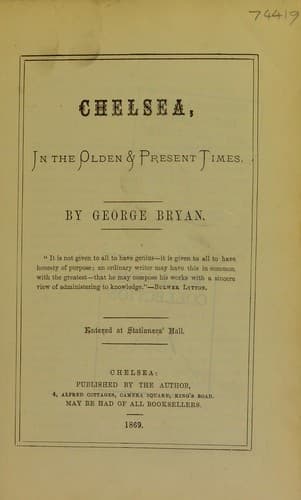
Chelsea, in the Olden & Present TimesBryan, George
History
Chelsea, in the Olden & Present Times
Bryan, George
Chelsea (London, England) -- History
As this road is the central great thoroughfare through Chelsea, some
early particulars respecting it cannot be otherwise than interesting. It
was originally only a footway through the fields, for the use of the
farmers and gardeners to get access to their lands; but soon after the
restoration of Charles II. it was found a convenient way for his Majesty
to go to Hampton Court Palace, and thus it was, after some discussion
between the Government and the parishioners of Chelsea, converted into a
coach road. The following extracts from the petition of Sir Hans Sloane,
Bart., Lord of the Manor, and other freeholders, will give a sufficient
detail of its history and origin, and from which it appears that disputes
had arisen concerning the right of way; and after the claims of the
inhabitants had been considered by the Lords Commissioners of his
Majesty’s Treasury, the matter was finally decided in their favour in the
year 1719, the 5th of George I.:—
TO THE RT. HON. THE LORDS OF HIS MAJESTY’S TREASURY, &c. {153a}
“That before the restoration of King Charles the Second, and some
time after, the fields of Chelsea were open fields; and that the
bridge, called Bloody Bridge, {153b} was only a foot-bridge, with a
plank or board; and the way leading thence to the lane facing
Blackland House, {153c} was then only a foot-path of about five feet
wide, and the lands on each side were plowed and sowed close up to
the same; and that from the said lane to the town gate was only a
baulk, or head land, of about ten or twelve feet broad, or
thereabouts; and the lands on each side of the said head-lands were
also ploughed up to the edges thereof; and that the said head-land
was used by the owners and occupiers of the said lands for a way,
egress and regress, to their lands, with ploughs and other utensils
of husbandry, and to carry off their crops from their lands, time out
of mind. That some time after the restoration, King Charles II.
built Bloody Bridge, as it now stands; and, as we are informed,
agreed with the then Lord of the Manor, and others concerned, for the
said head-land, for his Majesty’s private road, allowing the
freeholders their ancient way through the same. Whereupon the king
made the road with gravel, and the landowners ditched out their lands
on each side of the same; and the king took upon him the repair of
the gate at the town end (which before was maintained by the
parishioners), and as soon as the fields were sown, was hung up and
shut, and, after harvest, was always open until seed time returned
again, as many yet alive well remember. And ever since the
landholders of the said parish have been in possession of a free way
and passage to their lands through the said road, (some persons
having no other way,) and were never denied it during the reigns of
Public-domain text, read in full here on John Shaqi.
Reviews
Reviews
No reviews yet
Be the first to share your thoughts on this work.
Elsewhere in the archive
Join the Discussion
Join the discussion
Sign in to leave a comment or review.
Sign InorCreate an account