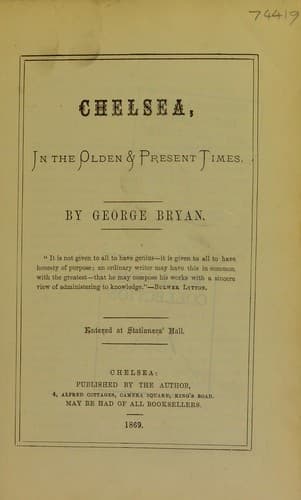
Chelsea, in the Olden & Present TimesBryan, George
History
Chelsea, in the Olden & Present Times
Bryan, George
Chelsea (London, England) -- History
In 1812 the Chelsea and Brompton Dispensary was established in Sloane
Square, principally through the great exertions of the Rev. George Clark,
M.A., the then chaplain of the Royal Military Asylum. At the meeting
convened for that purpose, the late W. Wilberforce, Esq., M.P., presided,
whose name will be ever associated with the abolition of slavery, and as
the advocate of almost every humane society in this country. This
admirable institution indicates the rapid growth of the population. The
earliest annual average of patients did not exceed 1200, in 1860 it was
upwards of 6000, and since the last date the number has greatly
increased. The first physicians were Dr. Ainsley and Dr. Adam Black, and
its first surgeons Robert Smith and Anthony Todd Thomson, Esqrs.
* * * * *
Mr. Fraser’s Botanical Grounds adjoined Sloane Square. He explored
distant parts of the world several times, so ardently attached was he to
botanical researches. He was patronized by a large number of the
nobility and gentry. His death took place, in 1811, at his residence.
* * * * *
It will be seen shortly that if the King’s Road, in the “Olden Times,”
was almost exclusively occupied by farmers and gardeners, that, for a
number of years afterwards, one of the principal attractions to it was
the many celebrated nursery and floricultural grounds.
* * * * *
The high wall at the Royal Military Asylum, which formed the back of the
boys’ lavatory, &c., and which stood more forward than the present
enclosure, had no pathway whatever against it, and the road being at one
part very narrow, it was not only inconvenient but at times dangerous.
* * * * *
Mr. Colvill’s Nursery Ground stood on the site of Colvill Terrace, and
the entrance to it was at the eastern corner. His display of flowers
excited general admiration, and consequently an immense number of the
gentry generally paid him a daily visit during the summer season.. The
grounds, however, were only enclosed with an old wooden fence, and here
again there was no footway for passengers.
* * * * *
Mr. Thomas Davey was also a celebrated florist, and his ground was
opposite what was called the White Stiles, now known as the Royal Avenue
to Chelsea College. The origin of the former name arose from there being
an ornamental stile at the entrances.
* * * * *
Public-domain text, read in full here on John Shaqi.
Reviews
Reviews
No reviews yet
Be the first to share your thoughts on this work.
Elsewhere in the archive
Join the Discussion
Join the discussion
Sign in to leave a comment or review.
Sign InorCreate an account