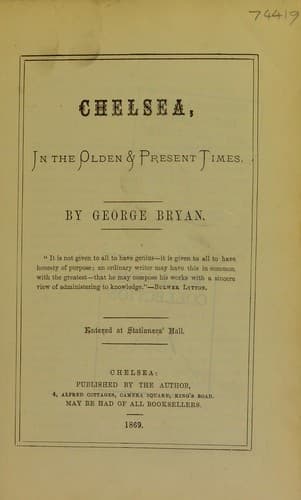
Chelsea, in the Olden & Present TimesBryan, George
History
Chelsea, in the Olden & Present Times
Bryan, George
Chelsea (London, England) -- History
The vast improvements which are everywhere conspicuous throughout the
length of the King’s Road, as regards that portion of it which is within
the boundaries of Chelsea, are far more numerous than in any other road
in the metropolis. At the eastern and western extremities of the parish,
there are Railway Stations, then there are the steamboats, besides these
there are the omnibuses traversing the road every quarter of an hour.
What a contrast does the King’s Road now present when compared with what
it was at the commencement of this century!
* * * * *
I now return to the bank of the Thames, passing through Flood Street,
proceeding eastward along Queen’s Road West, (formerly called Paradise
Row,) the residence of many of the Nobility and Gentry in the “Olden
Times.”
Queen’s Road West.
In the year 1664, Mr. James Hamilton, probably by order of the Lord of
the Manor, made a survey of this parish. It was further continued, till
the year 1715, by the Rev. Dr. King, the rector, to whose labours this
work is much indebted.
* * * * *
From Hamilton’s survey, it appears that the Earl of Radnor resided in
Paradise Row, {177} adjoining Robinson’s Lane. He entertained his
Majesty King Charles II. most sumptuously on the 4th of September, 1660,
at this house. When the above survey was taken, his relict, Lady Radnor,
was in possession of the premises. There are in the Parish Register
several entries of baptisms and deaths of this family. Lord Radnor died
at this house July 17, 1685, and Lady Radnor, his second wife, who
survived him, resided at Chelsea till her death in 1714. His son,
Francis, by his second wife, who was a gentleman of general learning and
good abilities, was buried at Chelsea.
* * * * *
At the north end of George Place, Queen’s Road West, formerly stood an
old white house, called “Queen Elizabeth’s Larder,” which was pulled down
to erect the present houses.
THE BOTANIC GARDEN.
On the south side of Queen’s Road West, near to the river, is situated
the garden belonging to the Company of Apothecaries. The earliest record
that we possess of a Botanical Garden in England, was that of the
celebrated John Gerarde, the father of English botany. The next in order
of time was that of the elder Tradescant, who, about 1630, established a
garden for the cultivation of exotic plants at South Lambeth; this
collection was presented, in 1667, to the University of Oxford. The next
garden in succession is this at Chelsea.
* * * * *
Public-domain text, read in full here on John Shaqi.
Reviews
Reviews
No reviews yet
Be the first to share your thoughts on this work.
Elsewhere in the archive
Join the Discussion
Join the discussion
Sign in to leave a comment or review.
Sign InorCreate an account