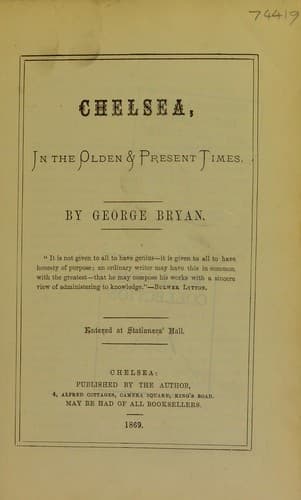
Chelsea, in the Olden & Present TimesBryan, George
History
Chelsea, in the Olden & Present Times
Bryan, George
Chelsea (London, England) -- History
The garden is laid out in divisions, in which the plants, shrubs, and
trees, are arranged systematically. On the south side of the garden,
facing the Thames, formerly stood two large cedars of Lebanon. Lysons
says, that Sir Joseph Banks made an accurate admeasurement of these
trees, in 1793, and found the girth of the larger to be twelve feet
eleven inches and a half, that of the smaller twelve feet and half an
inch. Upon being measured again, in 1809, they had increased twelve
inches in girth since 1793. There is now only one of these trees.
* * * * *
Mr. Philip Miller resided many years in the house at the garden, and
rendered himself particularly distinguished by his botanical works. He
succeeded to the office of curator of this establishment in 1722, and
resigned a little before his decease, which took place in 1771. He was
buried in Chelsea churchyard, where a monument has been since erected to
his memory by the Fellows of the Linnean and Horticultural Societies of
London. He was succeeded in the management of the garden by his pupil,
Mr. Forsyth, who, in 1784, was appointed chief superintendent of the
Royal Gardens at Kensington, which he held till his death in 1804. Mr.
Anderson was subsequently curator, and Mr. Wheeler demonstrator.
* * * * *
Having thus endeavoured to give a brief sketch of the rise and progress
of this establishment, it only remains to mention a few particulars in
reference to its present condition.
* * * * *
Within the last twenty-five years the garden has been in a great measure
remodelled, and in consequence has become better adapted to the purpose
for which it is maintained, namely, the instruction of medical students.
Several of the old hot-houses and greenhouses have been removed, and new
ones erected in their place; new arrangements of medicinal plants have
been formed; and groups representing the natural orders of plants have
been brought together to facilitate their study. Formerly two cedars of
Lebanon, some of the first planted in England, were conspicuous objects
from the river, but in 1853 one of these, which had become much decayed,
was blown down, the other still remains, but is gradually decaying, being
not only injuriously affected by the smoke of London, but like all the
other large trees in the garden, more or less damaged by the deprivation
of water caused by the construction of the deep sewer in the Queen’s
Road. A fine specimen of a rare tree, the Salisburia adiantifolia, the
Ginkgo of Japan, with leaves resembling those of the Maidenhair Fern in
form, may be seen towering above the wall in the Queen’s Road. The
alterations in this garden were commenced in 1846 by Mr. Robt. Fortune,
the Chinese traveller, who was succeeded, in 1848, by Mr. Thomas Moore,
the present Curator.
* * * * *
Public-domain text, read in full here on John Shaqi.
Reviews
Reviews
No reviews yet
Be the first to share your thoughts on this work.
Elsewhere in the archive
Join the Discussion
Join the discussion
Sign in to leave a comment or review.
Sign InorCreate an account