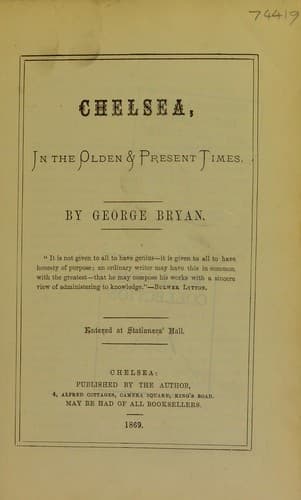
Chelsea, in the Olden & Present TimesBryan, George
History
Chelsea, in the Olden & Present Times
Bryan, George
Chelsea (London, England) -- History
She replied: “A dream I had last night, troubleth me sore.”
“What _was_ thy dream, Nell?”
“Methought I was in the fields at Chelsea, and slowly and
majestically there rose before mine eyes, a beautiful palace of a
thousand chambers; and in and out thereat walked divers many old and
worn-out soldier-men. Some had lost a leg, some an arm, others were
blind of an eye, many bore piteous scars of old wounds in the wars,
upon their wrinkled faces, and all of them were aged, and past
service. But none of them looked ill-at-ease, and as they went out,
and as they came in, the old men cried, ‘God bless King Charles!’ and
I awoke, and was sore discomfitted, that it was only a dream!”
“Cheer up, Nelly,” said the King. “Thy dream shall be fulfilled,
mayhap, thou shalt yet see old soldiers come in, and go out, crying,
‘God bless King Charles!’ The monarch did violence to his infirmity,
and kept his word.”
No appeal seems to have been made to the public at large, as was the case
with King James’s College; but while the voluntary contributions of the
charitable were received with gratitude, the troops were, to a certain
extent, burdened with the expenses of the asylum from which they were
themselves to derive the sole benefit. From the pay given to these, a
deduction was made of one shilling in the pound; which, being divided
into three equal parts, was one to defray the expenses of the Paymaster’s
office, one to the general use of the soldiers, and one to the
accumulation of a fund, first, for the building, and ultimately for the
maintenance of the hospital. By giving to this a retrospective effect,
so as to include the whole of the year 1680, and strengthened by
donations of £1,300 from Sir Stephen Fox, of £1,000 from Tobias Rustas,
Esq., of £1,000 from Sancroft, Archbishop of Canterbury, and of nearly
£7,000 from the Secret Service Fund, the projectors of the establishment
had at their disposal a sum of £17,012 14s. 7d. with which they
determined to make a beginning.
The edifice was consequently begun in the year 1682, but was not
completed till 1690. King Charles II., attended by a great number of the
principal nobility and gentry, laid the first stone of this magnificent
structure on the 16th of February, 1682. The whole expense of the
building is computed to have amounted to £150,000.
* * * * *
Sir Christopher Wren, to whose genius and abilities we owe the grandest
edifices of which our metropolis can boast, gave the original design, and
conducted the building to its completion.
* * * * *
Public-domain text, read in full here on John Shaqi.
Reviews
Reviews
No reviews yet
Be the first to share your thoughts on this work.
Elsewhere in the archive
Join the Discussion
Join the discussion
Sign in to leave a comment or review.
Sign InorCreate an account