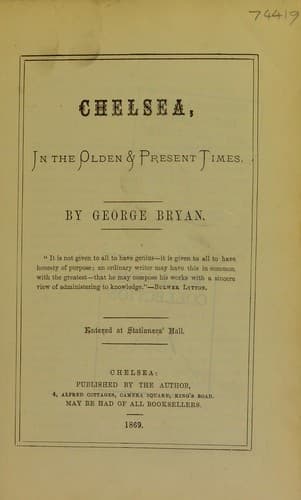
Chelsea, in the Olden & Present TimesBryan, George
History
Chelsea, in the Olden & Present Times
Bryan, George
Chelsea (London, England) -- History
Adjoining the Royal Hospital, on the eastern side, stood the mansion of
Richard, Earl of Ranelagh. This nobleman, about the year 1690, obtained
from the Crown a large grant of land; he built a house thereon, and made
it his principal residence till his death in 1712. In 1730 an Act was
passed vesting this estate in trustees, and three years after the house
and premises were sold in lots. About this period, Lacy, the patentee of
Drury Lane Theatre, projected a plan for establishing a place of public
entertainment on a large and splendid scale; and, in pursuance of this
scheme, he took a lease of these premises. But it appears he soon gave
up the undertaking, as in 1741, when the Rotunda was built, there were
two other lessees, one of whom became a bankrupt. The property was then
divided into 36 shares of £1000 each, the greater number of which were
held by Sir Thomas Robinson, who built for himself a house adjoining to
Ranelagh Gardens. Several of his friends took shares in the concern, and
it became for a time prosperous.
* * * * *
The Rotunda was opened with a public breakfast, &c., in 1742. It was an
imitation of the Pantheon at Rome. The external diameter was 185 ft.,
the internal 150 ft. The entrances were by four Doric porticos opposite
each other, and the first story was rustic; round the whole, on the
outside, was an arcade, and over it a gallery, the stairs to which were
at the porticos. The interior was fitted up with great taste, and from
the ceiling descended 28 chandeliers, in two circles. Music and dancing
were the principal attractions. From the branches of the trees that
shaded every walk festoons of coloured lamps hung down. Royalty,
nobility, and gentry visited it.
PRESENTATION OF COLOURS TO THE CHELSEA VOLUNTEERS.
On the 4th of January, 1804, a brilliant scene was displayed at Ranelagh,
on the presentation of Colours to the Chelsea Royal Volunteers. About
noon the trumpet announced the arrival of the Courtly party in three of
his Majesty’s carriages, followed by others belonging to different
noblemen. The company having alighted, Lady Harrington was conducted to
her box by the Vice-Chamberlain. The Countess being seated two pairs of
Colours were introduced, and placed on each side of the royal box. The
King’s Colours of each regiment consisted of a plain Union standard, but
the regimental one, which was designed and executed by the Queen and
Princesses, was a superb piece of needlework, the ground being a rich
purple silk, having in the centre his Majesty’s arms, embroidered and
surrounded with sprigs of variegated tints and figures. At the lower
corners were the letters “C. R.,” and under the armorial bearings the
words, “Queen’s Royal Volunteers.” {199} After prayers and a suitable
discourse, Lady Harrington thus addressed the officers:—
Public-domain text, read in full here on John Shaqi.
Reviews
Reviews
No reviews yet
Be the first to share your thoughts on this work.
Elsewhere in the archive
Join the Discussion
Join the discussion
Sign in to leave a comment or review.
Sign InorCreate an account