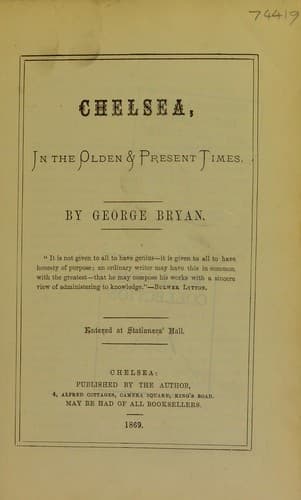
Chelsea, in the Olden & Present TimesBryan, George
History
Chelsea, in the Olden & Present Times
Bryan, George
Chelsea (London, England) -- History
At length the Crown purchased General Wilford’s house and the land
adjoining it, whereon the Rotunda formerly stood, for the use of Chelsea
Hospital, and when Lord John Russell (now Earl Russell) became
Paymaster-General, he caused the Ranelagh field, which was near the
river, to be laid out into portions or lots, for the old men to occupy,
each as his private garden. The remaining portion of the land of
Ranelagh, on the east, has since been added to the Hospital Gardens, and
presents one of the most picturesque specimens of gardening in the
vicinity of London. To these gardens the public have free access. Along
the side of them there is an excellent road leading to the Suspension
Bridge, and on the opposite side a splendid range of Barracks erected
within the last few years.
THE ORIGINAL CHELSEA BUNHOUSE.
Chelsea was famous for its buns from the commencement of the last
century. Swift, who lodged in Church Lane (street), and used to walk to
and from town, “two good miles, and just 5748 steps,” writes to Stella,
in 1712, “Pray, are not they fine buns sold here in our town? * * * Was
it not r-r-r-r-r-r rare Chelsea buns? I bought one in my walk.” This
old bunhouse was a rather long building of one storey, with a colonnade
in front, projecting over the pavement, the dwelling-house attached to it
standing in the rear, with a large and well-kept garden behind it. It
was situated in what was called Grosvenor Row, known as such at the time
the bunhouse was pulled down, the site of which is a little eastward
beyond the boundary line of this parish, and not far distant from Chelsea
Hospital. George II. and Queen Caroline, and the princesses, bought buns
here; as did George III. and Queen Charlotte, who presented to the
proprietor a silver half gallon mug, and five guineas in it. Here, on
Good Friday morning, £250 has been taken for buns; and so lately as 1839
no less than 240,000 buns were sold here on Good Friday. This may appear
to many an incredulous number; but few persons at the present time can
form an adequate idea of the immense demand for them.
* * * * *
The Rev. J. B. Owen, of St. Jude’s, Chelsea, in one of his admirable
lectures, delivered in 1860, humourously observed, “There is no poetry
more delicate, nor was street music more popular, than the old bellman’s
cry—‘Smoking hot, piping hot, Chelsea buns!’ Picture the enthusiasm of a
local rhymer thus immortalising the article:—
O flour of the ovens! a zephyr in paste!
Fragrant as honey, and sweeter in taste!
Hail to the bellman, who sings as he runs,
‘Smoking hot, piping hot, Chelsea buns!’
As flaky and white as if baked by the light,
As the flesh of an infant, soft, doughy, and slight;
The public devour thee like Goths and Huns,
‘Smoking hot, piping hot, Chelsea buns!’
Public-domain text, read in full here on John Shaqi.
Reviews
Reviews
No reviews yet
Be the first to share your thoughts on this work.
Elsewhere in the archive
Join the Discussion
Join the discussion
Sign in to leave a comment or review.
Sign InorCreate an account