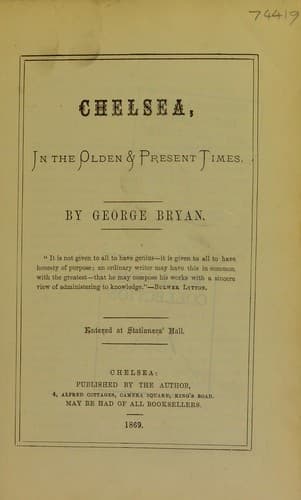
Chelsea, in the Olden & Present TimesBryan, George
History
Chelsea, in the Olden & Present Times
Bryan, George
Chelsea (London, England) -- History
On the 7th of January, 1827, a sermon was preached by the Rev. G. Clark,
M.A., chaplain, on the demise of the Royal Founder, at the conclusion of
which he thus addressed the children:—“I need not tell you that it has
pleased Almighty God to take away from this world the President of this
Institution, the Duke of York. He was the firm friend of your fathers,
and also a kind and steady friend to you, their children. Whatever
advantages you enjoy in this Asylum, you owe, under Divine Providence, to
the Duke of York. He was the founder of this Institution, and by his
recommendations and exertions it was begun and completed. Many of you
will remember this good friend who is now taken from us. A few months
ago you beheld him walk through your ranks; you saw in his countenance
the pleasure he felt from witnessing the healthy and creditable
appearance of so many children of British soldiers. I exhort you to hold
his memory in your hearts and affections; show your gratitude by
improving the advantages he has given to you in this Asylum, and by doing
your duty to God and man when you go forth into the world.”
* * * * *
The following tribute to the memory of the Duke of York was written by
Dr. Veitch, at that time physician to the Chelsea Dispensary:—“The
knowledge which his late Royal Highness possessed of human nature, and
what was becoming the character of British soldiers, induced him to
impress on their minds a system of discipline at once correct and
conveying lofty feelings; so that men thus trained were at all times
ready to prefer death to subjugation. We may here say, with truth, that
to the love of his country and the army he has prematurely fallen a
victim. No self-gratification, no pleasures, were ever by him allowed to
interfere with the duties he owed to the army and his country, and
however late his hour of going to rest, he was invariably the first man
at his post in the morning. We find individuals who are distinguished as
statesmen, as admirals, as generals, but who are without the smallest
pretensions to true greatness, because their talents and their courage
are not blended with the chivalrous, the gallant, and finer inspirations
flowing from the heart. Such men are generally anxious enough that their
services should be appreciated by their Sovereign, while they overlook
what they owe to others who have mainly contributed to their fame and to
their fortune. The late illustrious Duke had no such narrowness; his
soul was surrounded with generous and delicate attributes, rendering all
periods of his splendid career utterly inaccessible to deeds of darkness,
and also ever ready to expand to the light of truth, to the claims of
justice and of humanity; and he is therefore eminently entitled to the
character of a great man; because his high attainments in military
affairs were combined with an exalted and refined sense of courage and of
honour.”
* * * * *
Public-domain text, read in full here on John Shaqi.
Reviews
Reviews
No reviews yet
Be the first to share your thoughts on this work.
Elsewhere in the archive
Join the Discussion
Join the discussion
Sign in to leave a comment or review.
Sign InorCreate an account